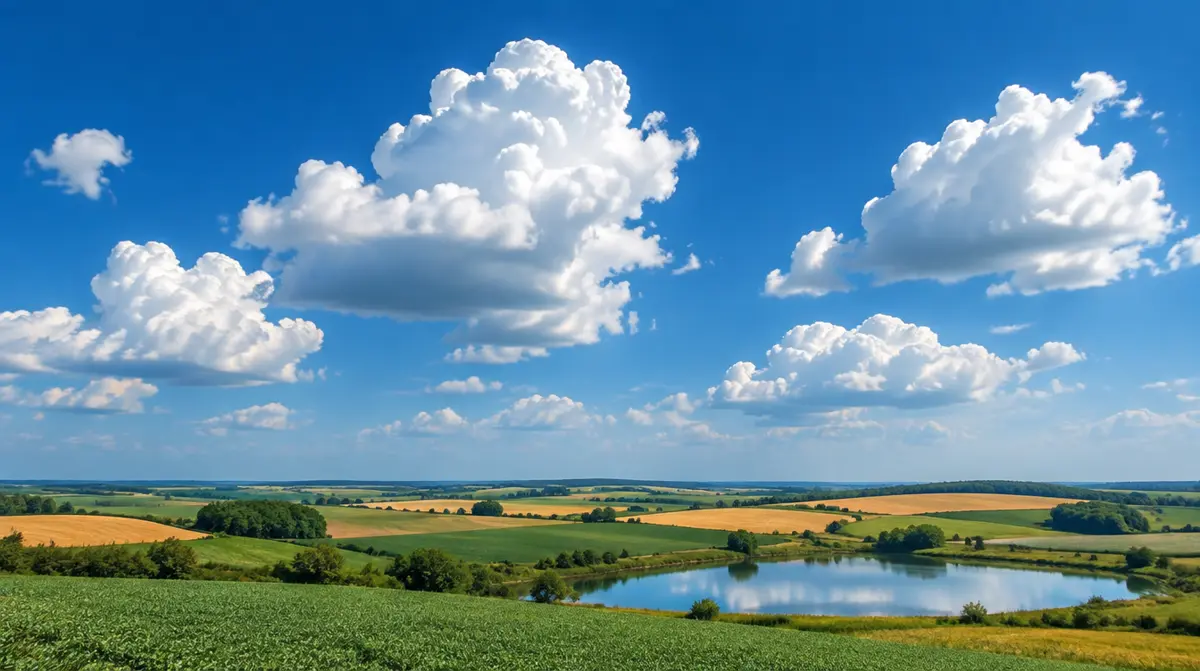
A single fluffy cloud can hold as much water as a swimming pool. Some weigh more than a jumbo jet.
So why do clouds float instead of crashing onto our heads? Because a cloud is made of droplets so tiny that they fall incredibly slowly, and the warm air rising from the ground keeps pushing them back up.
In this guide we follow one little droplet from the moment warm air lifts it off a sunny field to the moment it finally grows heavy and falls as rain. It is the same journey we animated in our short video, step by step and in the same order.
The Short Answer to Why Clouds Float
Clouds don’t really float like a balloon. Every droplet inside them is being pulled down by gravity all the time.
What saves them is a race they keep winning. Cloud droplets fall about one centimeter per second, slower than a snail on a wall. Meanwhile, the air that builds clouds is usually rising faster than that.
Three things work together to keep a cloud up.
- Tiny size. Each droplet is so small that air resistance almost cancels its weight.
- Rising air. Warm air currents called updrafts lift the droplets as they try to sink.
- Spread-out water. The water is scattered through an enormous volume of air, so a cloud as a whole is barely denser than the air around it.
Take away one of those and the cloud starts to fall. That is exactly what happens when it rains.
Step 1. Warm Air Rises From the Ground
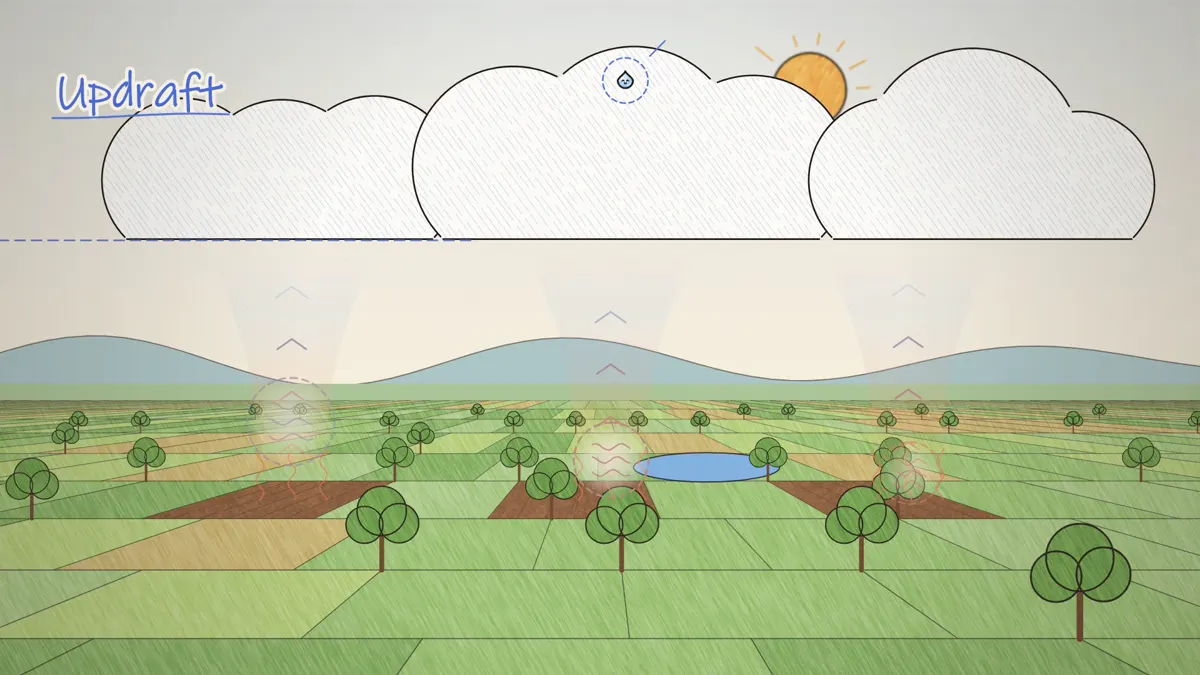
Our droplet’s story begins on a sunny morning over farmland. The Sun warms the fields, the soil and a small pond.
The ground then heats the thin layer of air touching it. Warm air expands, becomes lighter than the cooler air around it and starts to rise in invisible bubbles. Meteorologists call these bubbles thermals, and a column of rising air is an updraft.
Why do some spots make stronger thermals than others? A dark plowed field soaks up more sunlight than a lake or a forest, so it heats the air above it faster. That is why glider pilots and soaring hawks look for bare fields and sunny slopes.
Each thermal also carries something invisible. Water from the pond, the wet soil and the leaves of plants has evaporated into water vapor, and the warm bubble takes that vapor up with it.
Moist air is lighter than dry air
Here is a fact that surprises most people. Humid air is lighter than dry air at the same temperature and pressure.
A water vapor molecule is lighter than the nitrogen and oxygen molecules it replaces. So the more vapor a bubble of air carries, the lighter it gets. As the USGS Water Science School explains, the moist air inside a cloud is less dense than the dry air around it, and that helps it stay up.
Warmth and moisture make a powerful team. A warm, damp thermal rises easily, carrying its load of vapor higher and higher.
Step 2. Rising Air Cools and Vapor Turns Into Droplets
As the bubble climbs, the air pressure around it drops. With less air pressing on it, the bubble expands, and expanding air cools down.
How fast? Dry rising air cools by about 10 °C for every kilometer it climbs. That is why mountain tops are cold even on summer days.
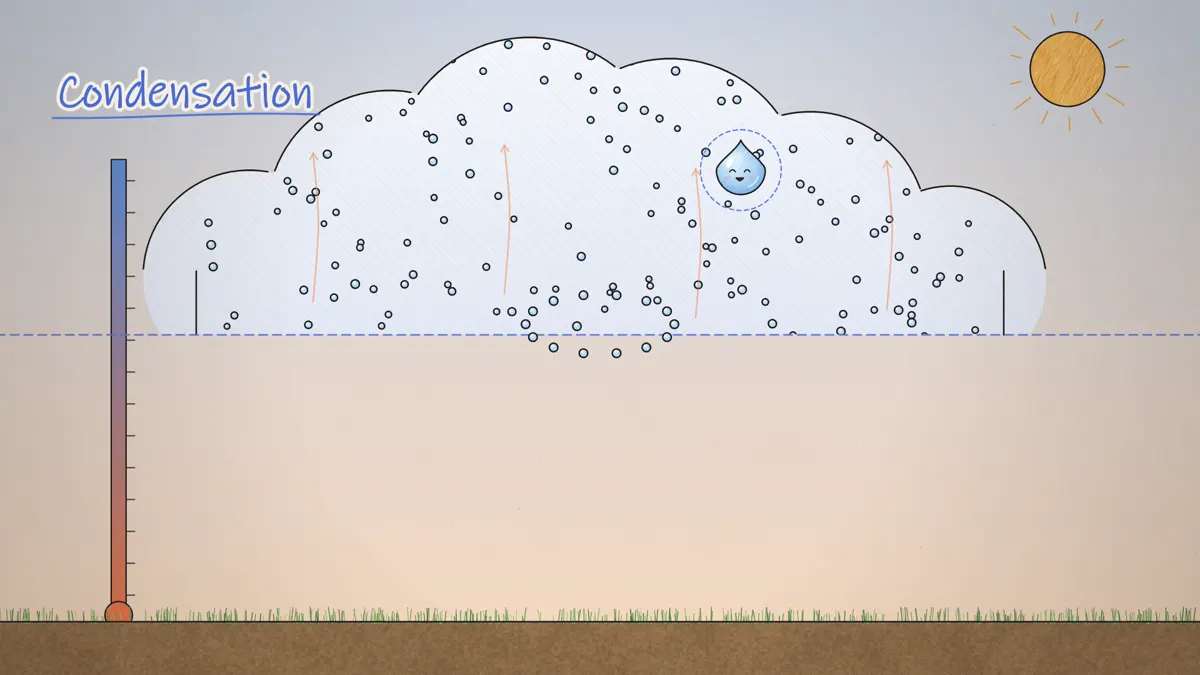
Cool air can’t hold as much vapor as warm air. When the bubble reaches the temperature called the dew point, the vapor starts changing back into liquid water. This change is condensation, and it is the moment a cloud is born.
You can often see that moment with your own eyes. On a summer day, look at the flat bottoms of puffy clouds. They all sit at the same height because that is the level where rising air reaches its dew point. Below it, the vapor stays invisible. Above it, the water becomes millions of droplets.
Every droplet needs a speck of dust
Vapor can’t easily form a droplet out of nothing. It needs a surface to grab on to.
The air is full of microscopic particles like sea salt, dust, pollen and smoke. Vapor condenses around them, and each particle becomes the seed of one droplet. Scientists call these seeds condensation nuclei.
So every cloud droplet has a tiny piece of the Earth hidden in its center. Without those specks, the air would have to cool far more before any cloud could appear.
Condensation also releases heat. That extra warmth makes the air inside the cloud a little warmer than the air around it, so it keeps rising. This is how a small puff can grow into a tall, towering cloud on a hot afternoon.
Step 3. How Much Does a Cloud Weigh?
Now our droplet is part of a full-grown cumulus cloud. It looks like cotton candy, but it is surprisingly heavy.
The USGS estimates that a typical puffy cumulus cloud about one cubic kilometer in size holds roughly 500,000 kilograms of water, about 1.1 million pounds. That is around the weight of 100 elephants.
So how can 100 elephants hang in the sky? Because those elephants are spread out over a gigantic space. A cubic kilometer of cloud contains about a billion cubic meters of air, and each cubic meter holds only around half a gram of liquid water. That is less than a small paperclip of water in a space the size of a big refrigerator.
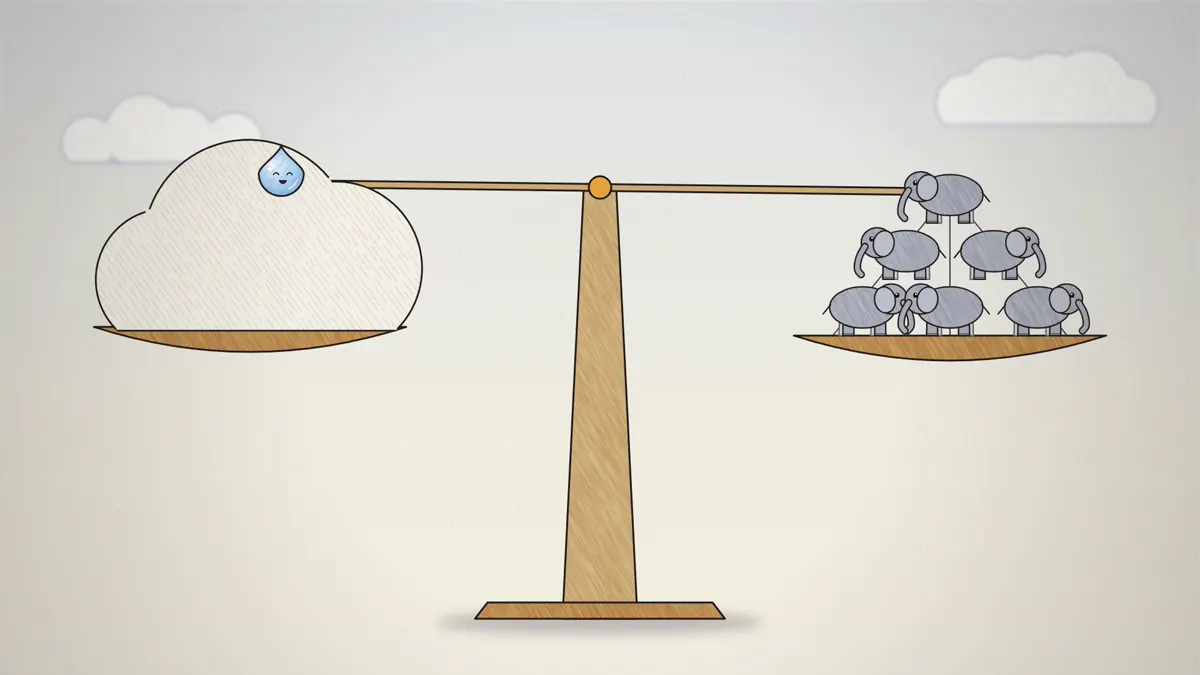
The air in that same space is far heavier than the water. A cubic meter of air near the ground weighs a little over one kilogram. Compared to that, the droplets add almost nothing.
| What we measure | Typical cumulus cloud |
|---|---|
| Size | About 1 cubic kilometer |
| Liquid water in each cubic meter | About 0.5 grams |
| Total water | About 500,000 kg (1.1 million pounds) |
| Same weight as | Roughly 100 elephants |
| Weight of the air in the same space | About a billion kilograms |
Look at the last two rows. The air in a cloud weighs about two thousand times more than the water floating in it. A cloud isn’t a heavy object sitting on the air. It is mostly air, with a light sprinkle of water mixed in.
Big storm clouds hold much more. A towering thunderstorm cloud can carry hundreds of times the water of a fair-weather puff. That is why those dark giants can pour out sudden, heavy rain.
Step 4. Why Tiny Cloud Droplets Barely Fall
Let’s zoom in on our droplet. It is round, smooth and astonishingly small.
A typical cloud droplet measures about 0.02 millimeters across, thinner than a human hair. An ordinary raindrop is about 100 times wider, and it takes roughly a million cloud droplets to build one raindrop.
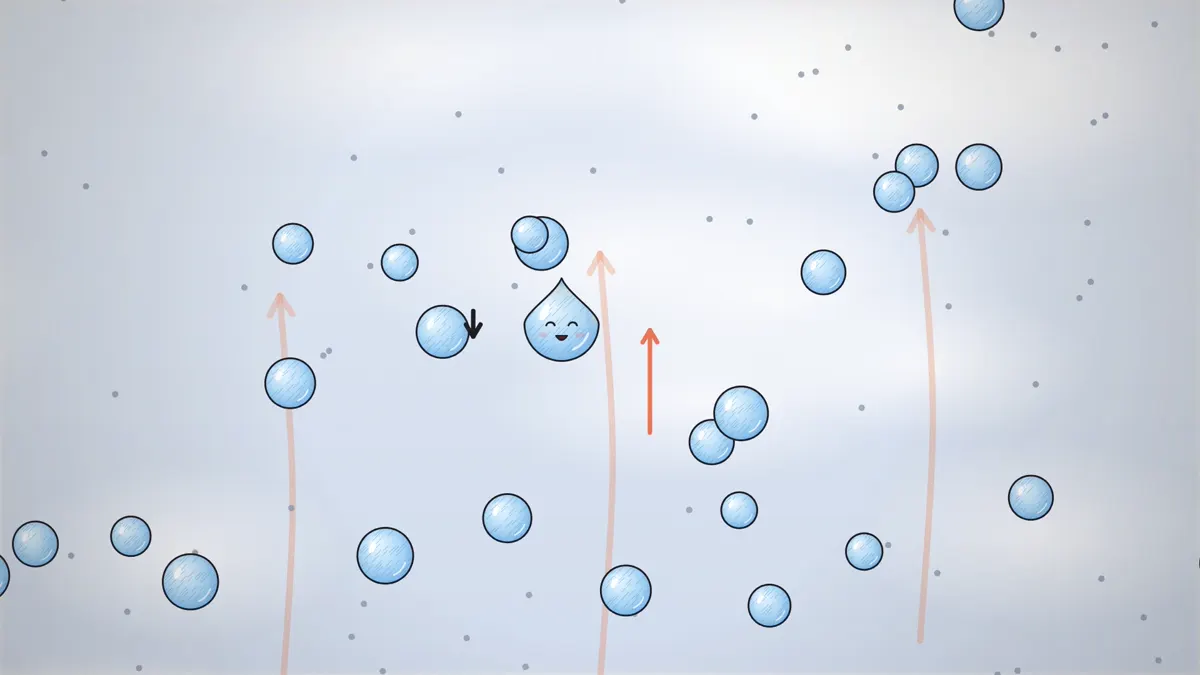
The battle between weight and air resistance
Every falling object pushes air out of its way. That push back from the air is called drag, or air resistance.
As an object falls faster, the drag grows. At some speed the drag becomes as strong as the object’s weight and it stops speeding up. That top speed is its terminal velocity.
Here is the key. When a drop gets smaller, its weight shrinks much faster than its surface does. A tiny droplet has a lot of surface for very little weight, so the air holds it back easily.
| Type of drop | Size | Falling speed in still air |
|---|---|---|
| Cloud droplet | About 0.02 mm | About 1 cm per second |
| Drizzle drop | About 0.2 to 0.5 mm | About 1 to 2 m per second |
| Average raindrop | About 2 mm | About 6 to 7 m per second |
| Large raindrop | About 5 mm | About 9 m per second |
At one centimeter per second, a cloud droplet would need more than a day to fall from a cloud one kilometer high, and in real life it would never make it. Long before it reached the ground, it would drift into drier air and evaporate.
Updrafts win the race
Now add the rising air. Inside a fair-weather cumulus cloud, updrafts often move at one to several meters per second. In a thunderstorm they can top 25 meters per second.
Compare that with the droplet’s one centimeter per second. The air is rising hundreds of times faster than the droplet is falling. So even though our droplet is always sinking through the air, the air itself carries it upward.
It is like walking slowly down an escalator that is going up. You keep stepping down, but you still end up higher.
Why do clouds look solid if they are made of droplets?
Billions of droplets scatter sunlight in every direction. All colors bounce around equally, so the cloud looks bright white and seems to have a solid surface.
When a cloud grows very thick, less light makes it through, and its base turns gray. That darker color is a hint that the cloud is holding a lot of water. A sunbeam meeting raindrops instead of cloud droplets can do something even prettier, which we explain in how a rainbow forms.
Step 5. Coalescence, When Droplets Grow Too Heavy
Clouds don’t hold their droplets forever. Sooner or later some of them grow.
Inside the cloud, droplets are bumped around by gusts. A slightly larger droplet falls a tiny bit faster than its neighbors, so it bumps into them and swallows them. Each merger makes it bigger, which makes it fall faster, which helps it catch even more droplets. This snowball process is called coalescence.
In our video, our little droplet keeps colliding with its neighbors and slowly turns into a plump drop. Its downward arrow grows longer while the updraft arrow stays the same size. That is the moment the balance flips.
In colder clouds there is a second path. Tiny ice crystals grow by stealing vapor from nearby droplets, get heavy, and often melt into rain on the way down. Much of the rain in the world starts as snow high in the clouds.
Step 6. Precipitation, When the Cloud Finally Lets Go
Once a drop becomes too heavy for the updraft to hold, gravity wins. The drop falls out of the bottom of the cloud as precipitation.
That is the real answer to why clouds don’t fall. Clouds do fall, one drop at a time, but only when those drops grow big enough to beat the rising air.
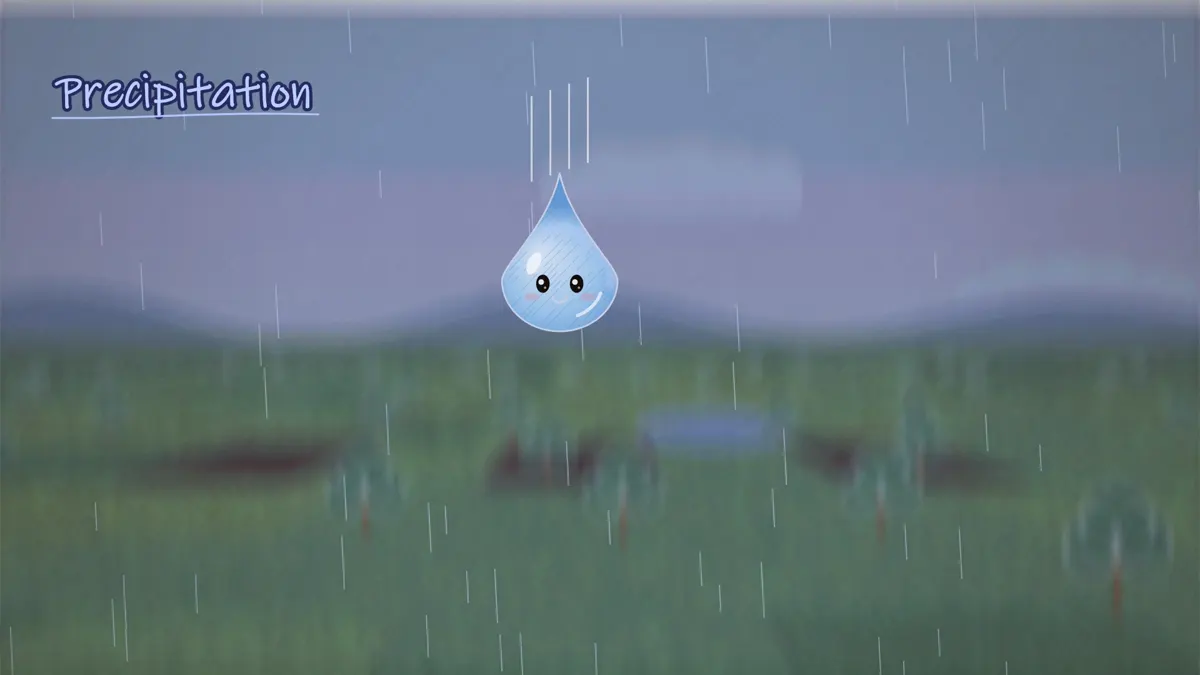
Our drop now races toward the ground at several meters per second. Along the way, air pushes against its bottom and flattens it, so it isn’t shaped like a teardrop at all. We show its true shape in what shape a raindrop really is.
The drop lands in a puddle among the grass. A few hours later the Sun comes out, the puddle warms up and our water evaporates again. As vapor, it rides a new thermal up into the sky and becomes part of another cloud. This loop is the heart of the water cycle, and clouds are its middle stop.
Why Do Some Clouds Disappear Instead of Raining?
Many clouds never rain at all. You can watch a small puffy cloud fade away in a few minutes on a sunny afternoon.
This happens when the updraft feeding it stops. Without rising air, the cloud slowly sinks into lower, warmer and drier air. The droplets evaporate back into invisible vapor and the cloud vanishes.
So a cloud is less like an object and more like a process. It only exists while air keeps rising and cooling. When that stops, it disappears, even though the water is still there as vapor.
Different Clouds, Different Ways of Staying Up
Not every cloud floats for the same reason. Each type depends on a different kind of rising air.
| Cloud type | What keeps it up |
|---|---|
| Cumulus | Warm thermals rising from sunny ground |
| Stratus | Very gentle, wide lifting of a whole layer of moist air |
| Cirrus | Tiny ice crystals high in the sky, falling so slowly that winds stretch them into wisps |
| Orographic clouds | Wind forced upward as it climbs over mountains |
| Cumulonimbus | Powerful updrafts strong enough to hold up hail |
Fog is the odd one out. It is simply a cloud touching the ground, formed when air near the surface cools to its dew point. Its droplets are just as tiny, so they hang in the air the same way.
The biggest storm clouds have updrafts so strong that they toss ice up and down until it grows into hail. Those same towers build the electric charges that end in lightning, and you can learn what happens next in what causes thunder.
Try It at Home. See Why Clouds Float
You don’t need a lab to watch these ideas in action. These quick activities use things you already have.
- Dust in a sunbeam. Close the curtains and let one beam of sunlight into a room. The floating dust specks are tiny like cloud droplets. Watch how they hover and drift for a long time instead of dropping straight down.
- Big drop, small drop. Use a spray bottle set to fine mist and a dropper. Spray a mist and let one big drop fall from the same height. The big drop hits the floor at once, while the mist lingers in the air.
- Cloud in a jar. Pour a little hot water into a jar, add a spritz of hairspray as condensation nuclei and cover it with a lid full of ice. A small cloud swirls inside, made of droplets that float above the water.
- Warm air rises. With an adult, hold a light paper spiral over a warm radiator or lamp. The rising warm air makes it spin, just like a thermal under a cloud.
Frequently Asked Questions About Why Clouds Float
Why do clouds float if they are made of water?
Clouds float because their water is split into tiny droplets that fall only about one centimeter per second. Rising warm air pushes upward faster than that, and the moist air inside the cloud is slightly lighter than the dry air around it.
How much does a cloud weigh?
A typical puffy cumulus cloud about one cubic kilometer in size holds around 500,000 kilograms of water, roughly the weight of 100 elephants. That water is spread through so much air that each cubic meter holds only about half a gram.
Why don’t clouds fall from the sky?
The droplets in a cloud are always sinking slowly, but updrafts carry the air upward faster than they fall. When droplets merge into drops too heavy for the updraft, they do fall, and we call that rain.
What are clouds made of?
Clouds are made of billions of tiny liquid water droplets, ice crystals or a mix of both. Each droplet forms around a microscopic particle such as dust, sea salt or pollen.
Why are some clouds white and others gray?
Thin clouds scatter all colors of sunlight equally, so they look white. Thick clouds full of water let less light through, so their bottoms look gray or dark, which often means rain is on the way.
Can clouds float without wind?
Yes, for a while. Even in calm air, cloud droplets fall so slowly that they would take more than a day to drop a kilometer. Without rising air, though, the cloud usually sinks into drier air and evaporates.
A Cloud Is a Balancing Act in the Sky
Every cloud you see is a balance between gravity pulling down and warm air pushing up. Tiny droplets, rising air and spread-out water keep 100 elephants’ worth of water drifting above our heads.
When the droplets grow too big, the balance tips and the cloud gives its water back as rain. Watch our short video above to follow one droplet through the whole adventure, and keep exploring the sky with our guides on raindrops, rainbows and thunder.