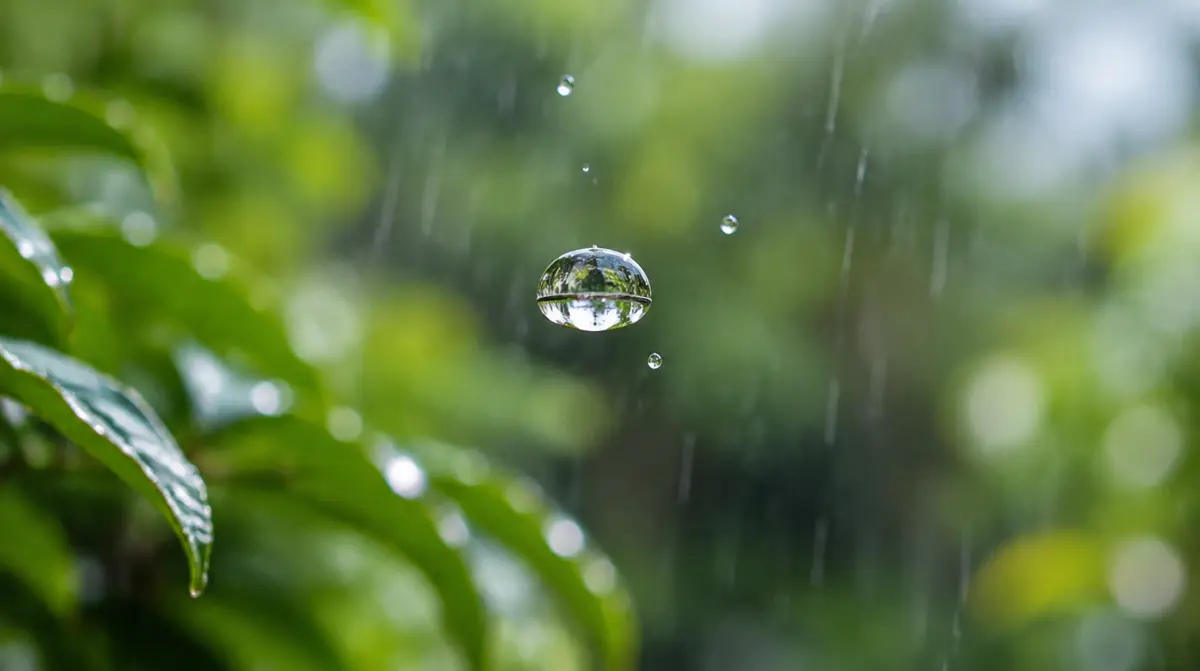
Ask anyone to draw a raindrop and you will get the same picture. A round bottom, a pointy top, a little tail. Weather apps use it, umbrellas use it, cartoons use it.
There’s just one problem. Falling raindrops almost never look like that.
So what shape is a raindrop? Small raindrops are tiny spheres. Medium raindrops are round on top and flat on the bottom, much like the top half of a hamburger bun. The biggest drops puff up like a parachute and then burst into smaller drops. The teardrop shape only shows up for a moment, while a drop is still hanging from a leaf or a faucet.
In this guide we follow one drop from the leaf where it is born to the lotus pad where it lands, the same journey we animated in our short video. Each stage shows a different force changing its shape.
The Short Answer, Raindrop Shapes by Size
A raindrop’s shape depends almost entirely on how big it is. Size decides which force wins, the inward pull that keeps water round or the push of air that squashes it.
| Drop size (diameter) | Shape while falling |
|---|---|
| Smaller than about 1 mm | Almost a perfect sphere |
| About 1 to 4 mm | Round top, flattened bottom, like a hamburger bun |
| Larger than about 4.5 mm | Hollow underneath like a parachute, then breaks apart |
Notice what is missing from that table. No size of falling raindrop has a pointed tip. The famous teardrop is a cartoon, not a weather fact.
Why does this matter beyond fun trivia? Weather radars and satellites measure rain by bouncing signals off drops. Knowing how flat the drops are helps scientists turn those signals into accurate rainfall numbers.
Where the Teardrop Idea Comes From
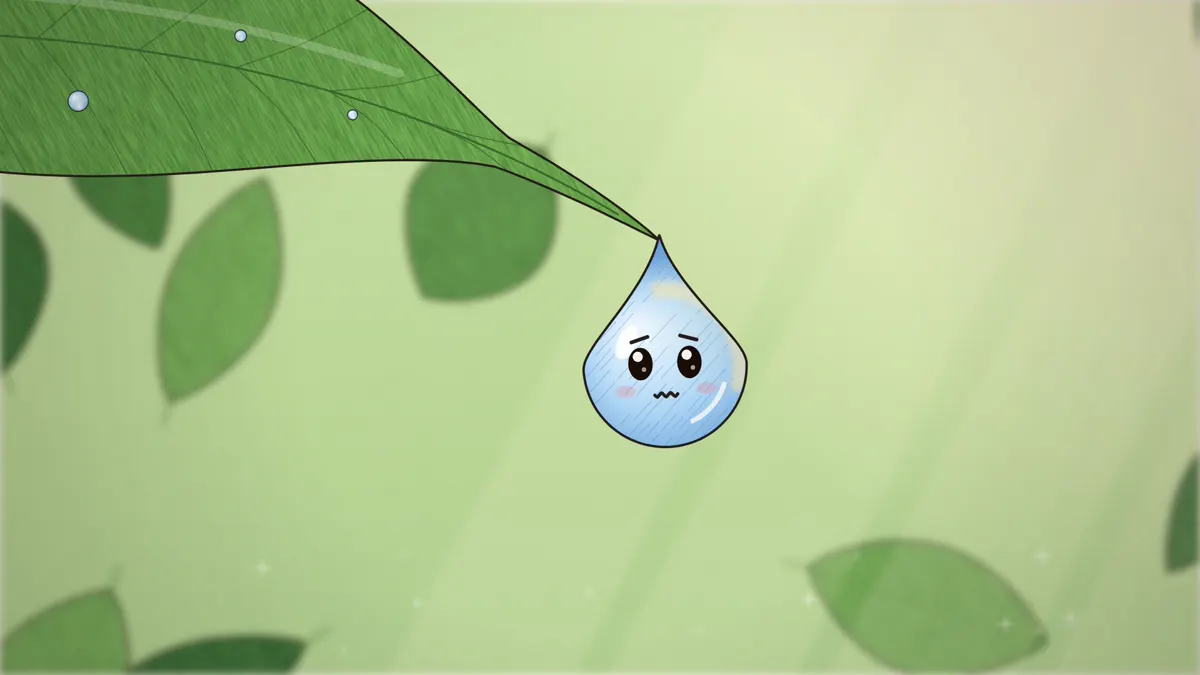
Our video opens on a drop clinging to the tip of a leaf. It swells, sags and stretches downward. In that moment it really does look like a teardrop.
Why? Because the drop is stuck to something. The top of the water holds on to the leaf while gravity tugs on the bottom. The water stretches into a neck, wide at the bottom and thin at the top.
The same thing happens with a dripping faucet. If you watch slowly, you see a drop grow, stretch and hang by a thin thread of water.
So artists are not completely wrong. They are drawing a hanging drop, not a falling drop. The trouble is that we see dripping water up close every day, and we almost never see a real raindrop in mid-air, because it moves far too fast for our eyes.
Pinch-off, the moment a drop lets go
As the hanging drop gets heavier, the thin neck at the top gets thinner and thinner. Finally it snaps. Scientists call this pinch-off.
In our animation the drop bounces free and its tail disappears almost instantly. The tiny thread left behind often forms its own mini droplet, called a satellite drop. You can sometimes spot one as a second, smaller drip right after the main one.
And as soon as the drop is free, its pointy top vanishes. Which brings us to the force that rounds it off.
Surface Tension, Why a Free Drop Turns Round
Every water molecule is attracted to the molecules around it. Deep inside a drop, a molecule gets pulled equally in every direction, so it feels balanced.
A molecule on the surface is different. It has neighbors beside it and below it, but none above it in the air. So it gets pulled inward. Billions of surface molecules pulled inward at once act like a stretchy skin wrapped around the drop. That skin is surface tension.
What shape does a stretchy skin like best? The one with the smallest possible surface for the water inside. That shape is a sphere. It’s the same reason soap bubbles are round.
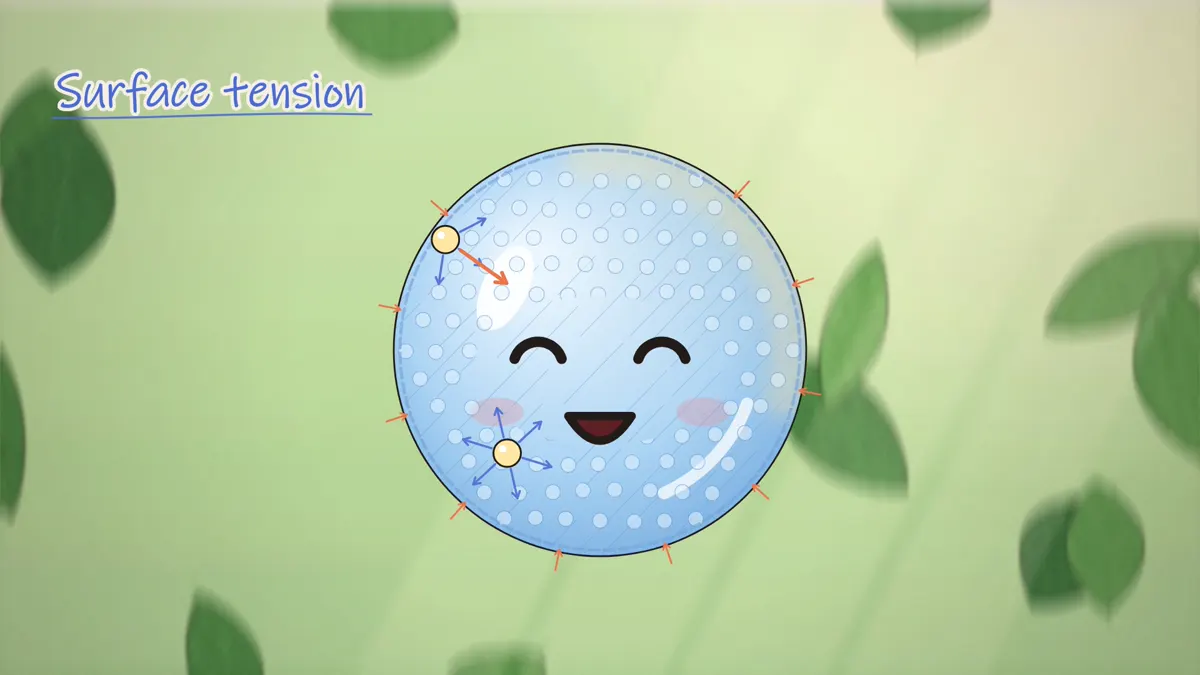
In the video we show this as a small tug of war. When the drop tries to stretch into a point, surface tension pulls the tip back in, and the drop smiles again as a ball. Any bump or tail gets smoothed away within a fraction of a second.
Why water has such a strong skin
Water molecules stick to each other unusually well because of hydrogen bonds, weak links between the hydrogen of one molecule and the oxygen of the next. That is why water’s surface tension is higher than that of most everyday liquids, like oil or alcohol.
You can see it at home. Fill a glass to the brim and keep adding water slowly with a spoon. The water rises above the rim in a dome before it spills. Insects called water striders walk on ponds using the same invisible skin.
For a very small drop, this skin is all that matters. Drops smaller than about 1 mm fall gently, the air barely pushes on them, and they stay nearly perfect little spheres all the way down. Drizzle and the droplets inside clouds look like this.
Air Drag, the Force That Flattens a Falling Raindrop
Now our drop starts to fall. In the video, the camera pulls back to show a tree, a pond and a long ruler of air between them. Gravity takes over and the drop speeds up.
But the drop is not falling through empty space. It is pushing through air, and air pushes back. That push is called air drag or air resistance.
Where does the air push hardest? Right on the bottom of the drop, the side that is crashing into the air. The pressure underneath rises, and the soft underside of the drop gets pressed flat.
Meanwhile, air flows around the sides of the drop faster, and the pressure there drops a little. The sides bulge outward. The top, where the air is calmest, stays rounded thanks to surface tension.
Put it together and you get a drop that is wide, flat on the bottom and domed on top. That’s the shape NASA’s Global Precipitation Measurement mission compares to the top of a hamburger bun.
Why bigger drops get flatter
Two things change as a drop grows. It falls faster, so the air pushes harder. And its surface tension skin is stretched over a larger area, so it holds the shape less tightly.
A small drop is like a tiny, tight balloon that resists squashing. A big drop is like a large water balloon that wobbles easily. The bigger the drop, the flatter its bottom.
Terminal Velocity, When a Raindrop Stops Speeding Up
Here is a fact that surprises most people. A raindrop that falls from a cloud kilometers high does not keep getting faster forever.
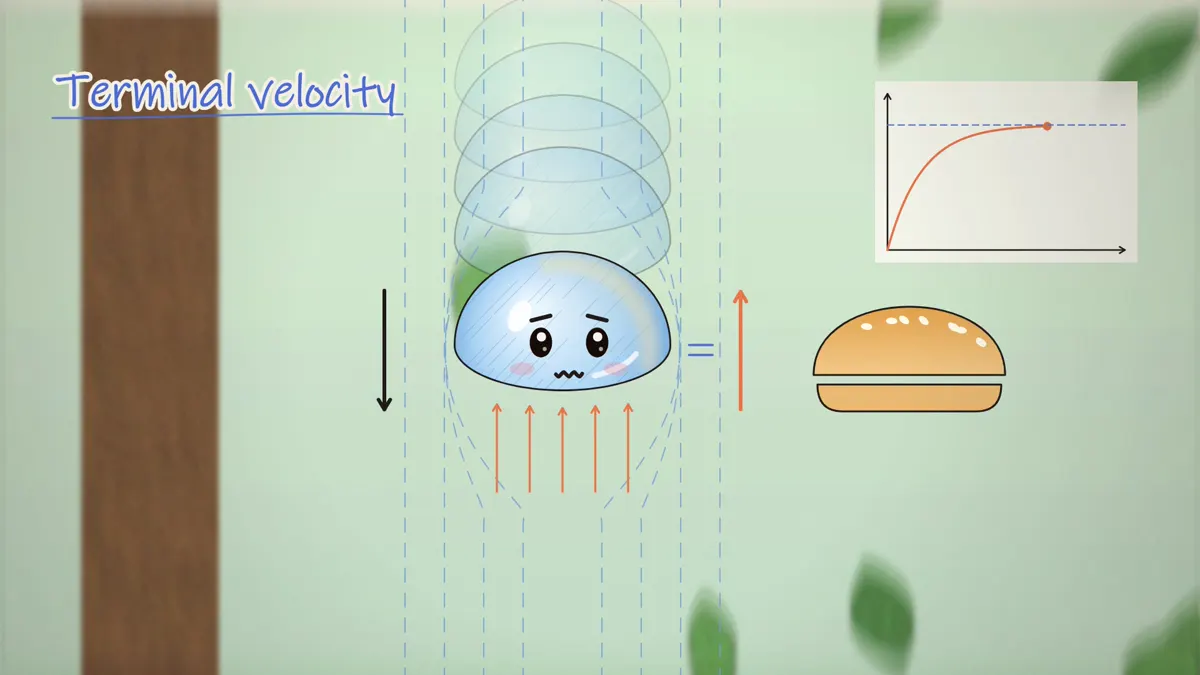
As the drop speeds up, air drag grows. At some point the upward push of the air becomes equal to the downward pull of gravity. The two forces cancel out and the drop stops accelerating. From then on it falls at a steady speed called its terminal velocity.
Our video shows this with a little graph. The speed line climbs fast, then bends and goes flat. At that exact moment, the drop holds its bun shape, and we put a hamburger bun right next to it so the comparison is impossible to forget.
How fast do raindrops fall?
Terminal velocity depends on size, because bigger drops have more weight for each bit of surface the air can push on.
| Type of drop | Approximate falling speed |
|---|---|
| Cloud droplet (about 0.02 mm) | About 1 cm per second, it barely falls |
| Drizzle drop (about 0.5 mm) | About 2 meters per second |
| Average raindrop (about 2 mm) | About 6 to 7 meters per second |
| Large raindrop (about 5 mm) | About 9 meters per second |
Nine meters per second is roughly 32 kilometers per hour, about the speed of a fast bicycle. That is quick enough to sting on your face, but nowhere near dangerous. Without air drag, a drop falling from a high cloud would hit the ground many times faster.
Look at the first row too. Cloud droplets fall so slowly that the gentlest rising air keeps them up. That is a big part of the answer to why clouds float instead of crashing down.
Why Big Raindrops Break Apart
So what happens when a drop keeps growing? Inside a rain cloud, drops collide and merge, and some get quite large. But there is a size limit.
Once a drop grows past about 4.5 mm across, the air pushing on its flat bottom becomes stronger than surface tension can resist. The underside gets pushed inward, and the drop turns into a hollow dome, like an upside-down bag or a tiny parachute.
The water skin around that dome gets thinner and thinner. Then it bursts. The drop shatters into a ring of smaller drops, which instantly pull themselves back into spheres and buns.
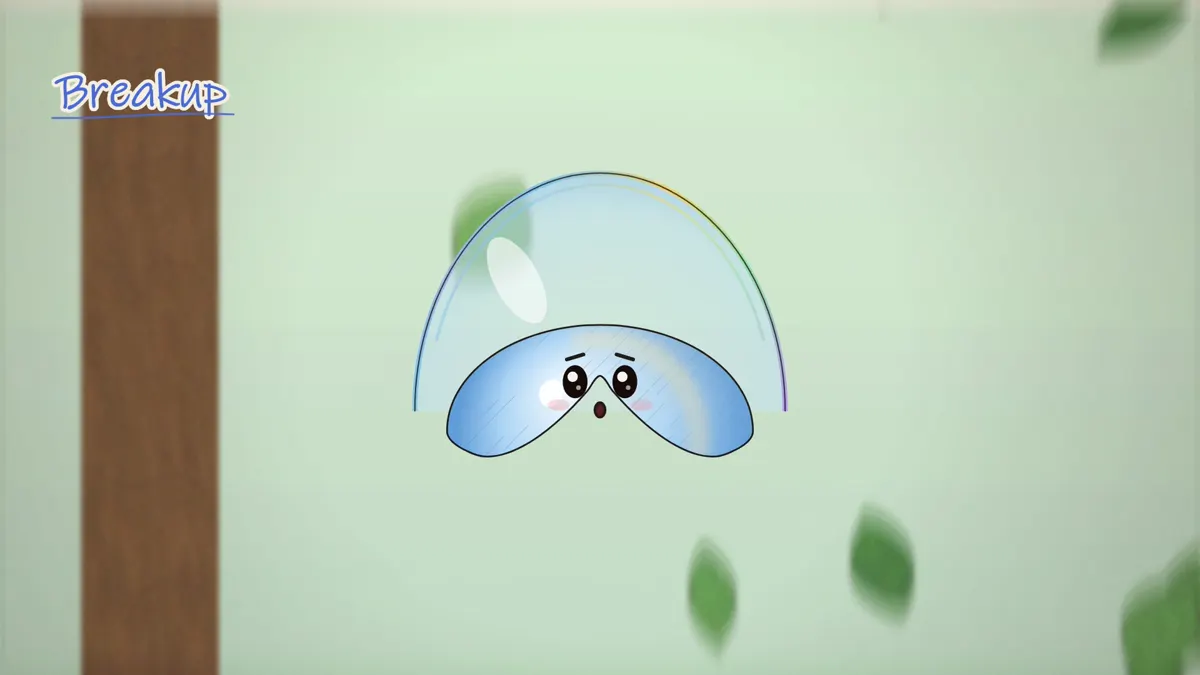
In our animation this is the moment the drop’s face looks worried. The bubble balloons above it, and a second later it splits into several little drops that keep falling.
The largest raindrops ever measured
Because of breakup, most raindrops stay between about 1 and 4 mm. Drops of 5 to 6 mm are rare. The biggest drops scientists have recorded, close to 1 cm across, were seen in clouds where they had just formed and had no time to break.
Breakup also explains why heavy storms don’t drop giant water balloons. The air itself keeps raindrops small, no matter how much water a cloud holds.
What Happens When the Raindrop Lands
Our drop’s last stop is a pond full of lotus leaves. The splash scatters it into many tiny drops that roll across the leaf instead of soaking in.
Why don’t they spread out and wet the leaf? Because a lotus leaf is one of the most water-repellent surfaces in nature. Its surface is covered with microscopic bumps topped with a waxy coating. Water touches only the tips of those bumps, with pockets of air underneath.
Barely touching the leaf, each drop is free to do what surface tension wants. It pulls itself into an almost perfect ball and rolls away like a marble, picking up dust as it goes. Scientists call this self-cleaning trick the lotus effect.
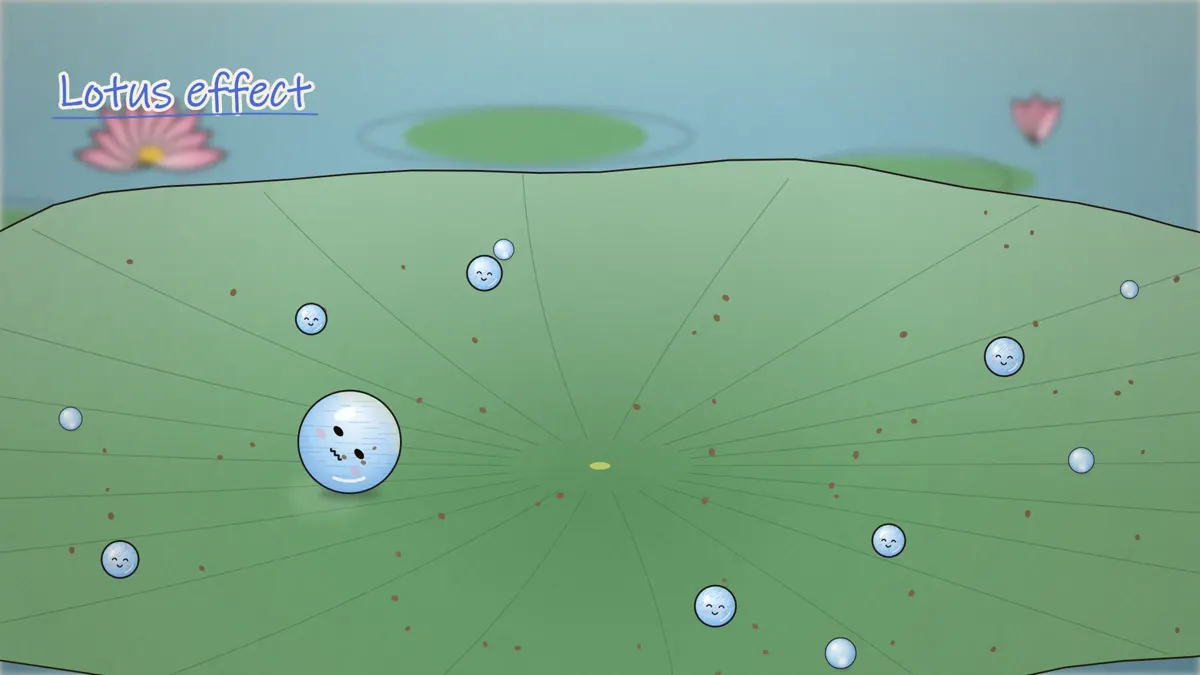
So the story ends where it began, with surface tension. A drop resting on a water-repellent leaf is round again, while a drop sitting on clean glass spreads out flat. The shape of water always depends on what it is touching and which force wins.
Engineers now copy the lotus leaf for self-cleaning paints, rain jackets and windows. All from watching how a raindrop sits on a leaf.
The Raindrop’s Whole Journey, Step by Step
Here is the full sequence from our video, with the force in charge at each stage.
- Hanging. The drop clings to a leaf tip and gravity stretches it into a teardrop.
- Pinch-off. The thin neck snaps and the drop falls free.
- Surface tension. The free drop pulls itself into a sphere.
- Air drag. As it speeds up, air flattens its bottom.
- Terminal velocity. Drag equals gravity, the speed stays steady and the drop holds its bun shape.
- Breakup. Drops that grow too large become parachutes and split into smaller drops.
- Landing. On a lotus leaf, the pieces bead up into tiny spheres and roll away.
The drop changes shape several times in just a few seconds. Raindrops are not one shape, they are a shape-shifting balance of forces.
Raindrops and the Bigger Picture
Every one of these drops is a small part of something much larger. It started as vapor rising from oceans, gathered into a cloud and fell back down, as we explain in our guide to what the water cycle is.
Raindrop shape even shows up in the sky in color. A rainbow forms when sunlight bends inside drops and bounces back out. Because rounder small drops and flatter big drops bend light a bit differently, rainbows from drizzle look softer and paler than rainbows after a heavy shower. You can read more about it in how a rainbow forms.
The USGS Water Science School also notes that a single raindrop is built from roughly a million cloud droplets. Each bun-shaped drop that taps your window is the result of countless collisions high above you.
Easy Experiments to See Raindrop Shapes at Home
You can’t freeze a falling raindrop without a high-speed camera, but you can watch each force at work.
- The teardrop at the faucet. Turn a tap on so it drips slowly. Watch closely and you will see each drop hang, stretch a neck and pinch off. That’s the only real teardrop.
- Coin dome. Use a dropper to place water drops on a coin, one at a time. Count how many fit before the dome spills. Surface tension holds dozens.
- Leaf beads. Sprinkle water on a cabbage, nasturtium or tulip leaf. The drops roll into shiny balls, a home version of the lotus effect.
- Flour raindrops. Put a tray of flour outside during a light rain for a few seconds. Each drop leaves a tiny pellet. Bigger pellets come from bigger drops, so you can compare sizes from one shower to another.
Frequently Asked Questions About Raindrop Shape
Are raindrops shaped like teardrops?
No. Falling raindrops are never pointed. Small ones are spheres and medium ones are round on top and flat on the bottom. The teardrop shape only appears while a drop is hanging from something, like a leaf or a faucet.
Why are raindrops flat on the bottom?
Air pushes hardest on the underside of a falling drop, because that side runs into the air first. That pressure flattens the bottom, while surface tension keeps the top rounded.
What is the biggest a raindrop can get?
Most raindrops stay under about 4.5 mm. Larger drops get pushed into a parachute shape and break apart. Very rarely, drops close to 1 cm have been measured just after forming.
How fast does a raindrop fall?
An average raindrop falls about 6 to 7 meters per second, and the largest about 9 meters per second. They stop speeding up once air drag balances gravity, which is called terminal velocity.
Why are small water drops round?
Surface tension pulls water into the shape with the smallest surface, which is a sphere. Small drops fall so slowly that air barely pushes on them, so they stay round.
What is the lotus effect?
It is the way water beads up and rolls off a lotus leaf. Tiny waxy bumps keep the water from touching most of the leaf, so drops become little balls that carry away dirt.
A Tiny Bun Falling From the Sky
The next time it rains, picture what is really falling. Not little teardrops, but millions of tiny buns, spheres and bursting parachutes, each one shaped by the pull of surface tension and the push of the air.
Watch our short video above to see one drop go through every shape in under a minute, from leaf to lotus pad. Then go find a leaf, a faucet or a coin and test it yourself.