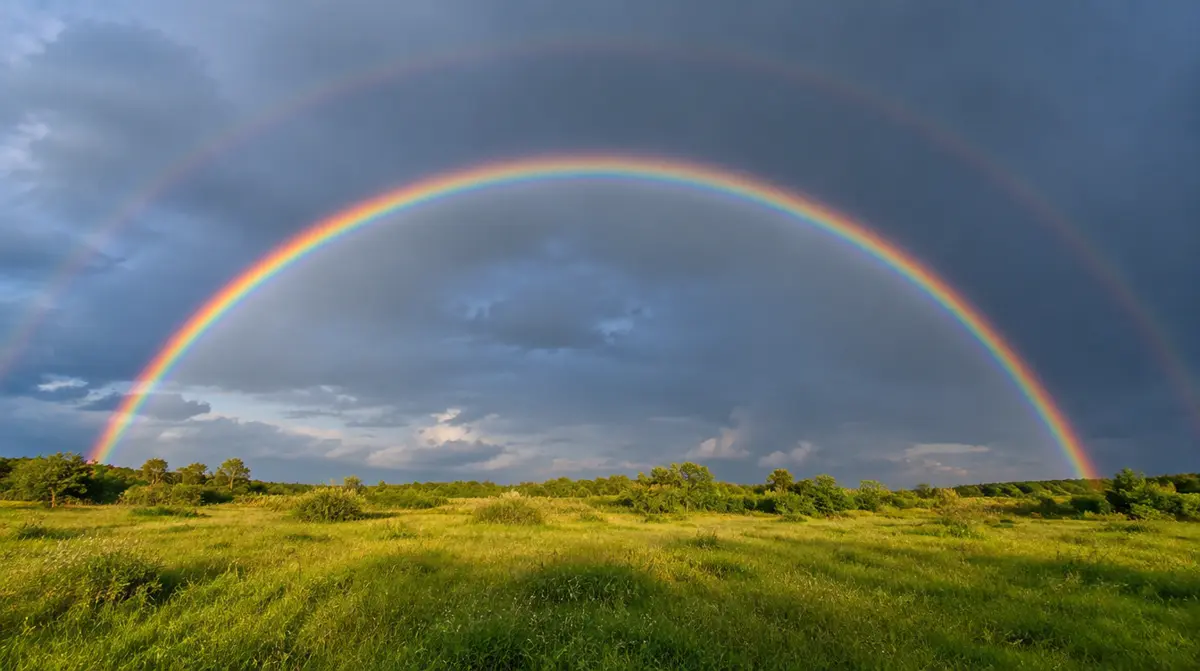
A rainbow looks like a solid bridge of color hanging in the sky. Yet you can never walk under it, and two friends standing side by side never see exactly the same one.
So how does a rainbow form? Sunlight enters millions of falling raindrops, bends, splits into its colors, bounces off the back of each drop and comes out again at a very precise angle. Your eye collects that light and sees a glowing arc.
In this guide we follow a single sunbeam into a single raindrop, the same journey we animated in our short video. By the end you will know why the colors always appear in the same order, why the bow is curved and why you need the Sun behind you to see it.
A Rainbow in One Sentence
A rainbow is sunlight that has been bent, split and reflected by raindrops, then sent back toward you at an angle of about 42 degrees.
Three ingredients make it happen. You need sunlight, you need drops of water in the air and you need to stand between them, with the Sun at your back and the rain in front of you.
Take away any one of them and the rainbow disappears. That is why rainbows show up after a shower, when the clouds break and the Sun shines on rain that is still falling somewhere else.
Is a rainbow an object? Not at all. It is an optical effect, light arriving at your eyes from many drops at once. Nothing is painted in the sky.
Step 1, the Sun Breaks Through the Clouds
Our video opens in the middle of a rain shower. A tiny raindrop falls among thousands of others under a grey sky.
Then the clouds tear open and the Sun appears. A straight beam of light travels across the sky and lands on our drop.
That beam looks white, but it is hiding a secret. White sunlight is a mix of every color, from red to violet, all traveling together. Each color is light of a different wavelength. Red has the longest waves and violet the shortest.
Isaac Newton proved this in the 1660s by shining sunlight through a glass prism and watching it fan out into a band of colors. A raindrop does the same job as his prism, only it is round and made of water.
Step 2, Refraction Bends the Light
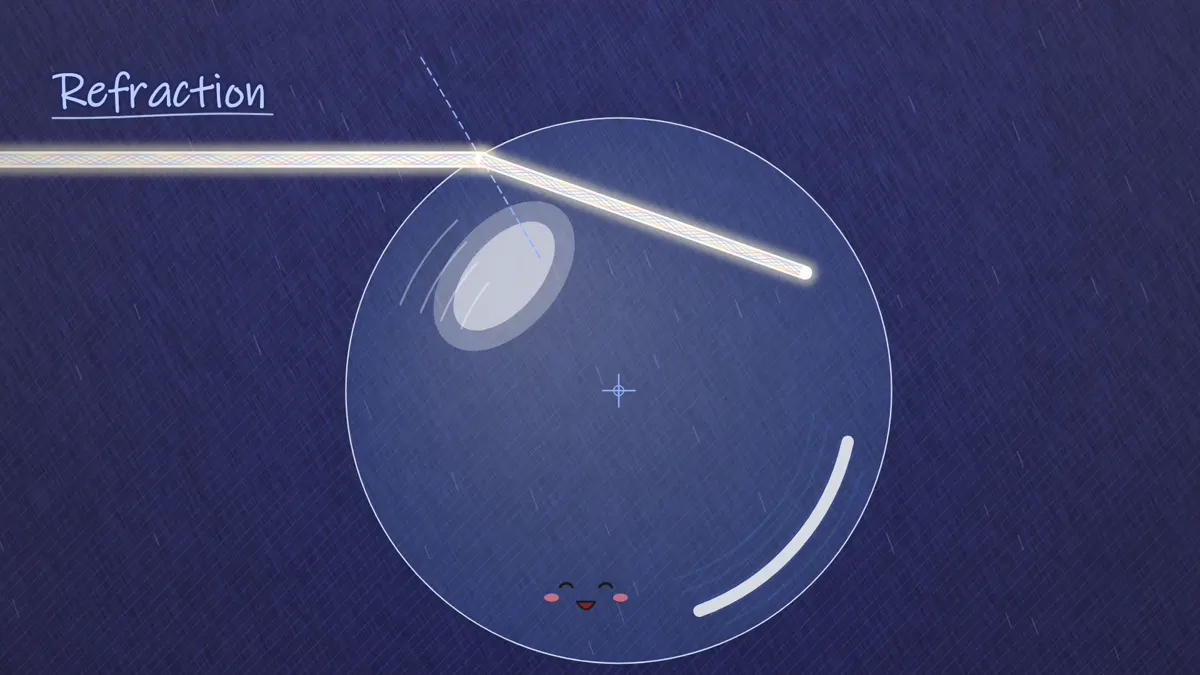
When the beam reaches the surface of the drop, it doesn’t keep going in a straight line. It bends. This change of direction is called refraction.
Why does light bend? Because it slows down. Light races through air at nearly 300,000 kilometers per second, but in water it travels about a quarter slower, close to 225,000 kilometers per second.
Picture a toy car rolling from a smooth floor onto a carpet at an angle. The wheel that touches the carpet first slows down first, so the whole car turns. Light entering water at an angle does the same thing.
Scientists measure this slowing with a number called the refractive index. For water it is about 1.33, which means light in water moves 1.33 times slower than in empty space.
Refraction you can see at home
Put a pencil in a glass of water and look from the side. The pencil seems broken at the surface.
The pencil is fine. The light coming from the part underwater bends as it leaves the water, so your eyes see it in the wrong place. It is the same bending that starts every rainbow.
Step 3, Dispersion Splits White Light Into Colors
Here is where the magic begins. Water does not bend every color by the same amount.
Violet light bends the most and red light bends the least. The other colors fall in between. So as the white beam enters the drop, it spreads apart into a fan of separate colors. This spreading is called dispersion.
In our animation the white beam touches the drop and suddenly opens into seven thin lines, red, orange, yellow, green, blue, indigo and violet. They were inside the white light all along, waiting for something to pull them apart.
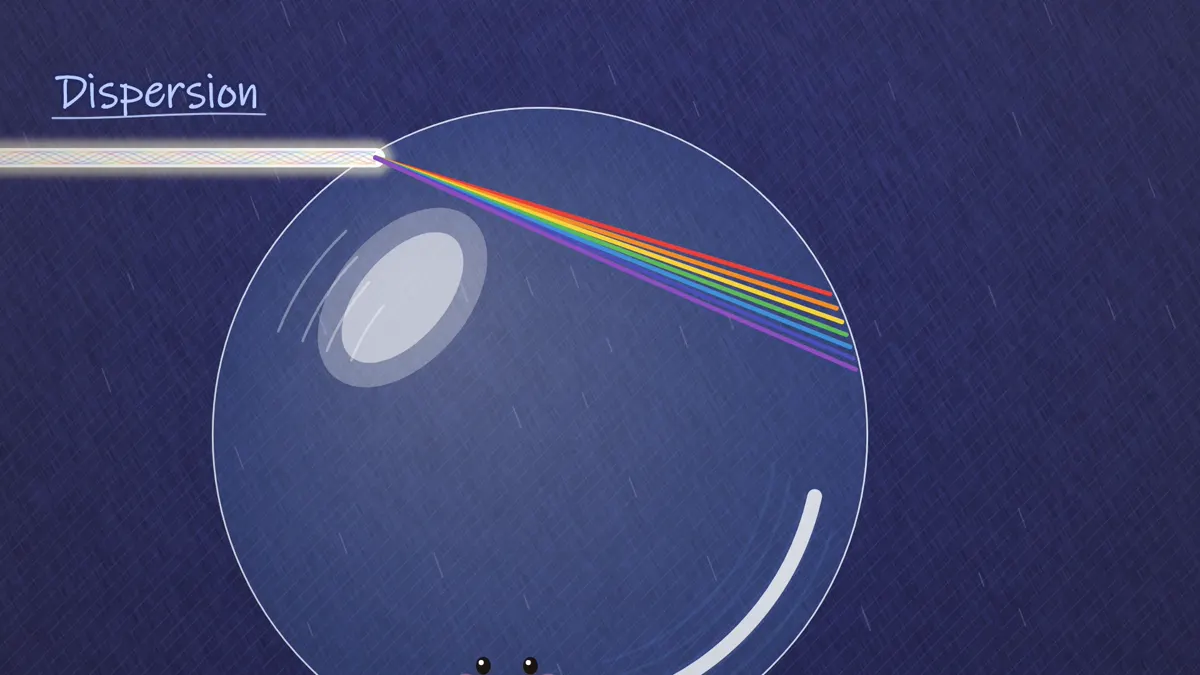
The difference in bending is small. Without the next step, the colors would stay too close together to notice. The inside of the drop is about to make the separation much bigger.
Step 4, Reflection Off the Back of the Drop
The fan of colors crosses the drop and hits its back wall. There, part of the light does not escape. It bounces back into the drop, just like light off a curved mirror. This is internal reflection.
Most of the light actually passes straight through the back of the drop and is lost. Only a small portion reflects. But a rain shower has billions of drops, so that small portion is still bright enough to light up the sky.
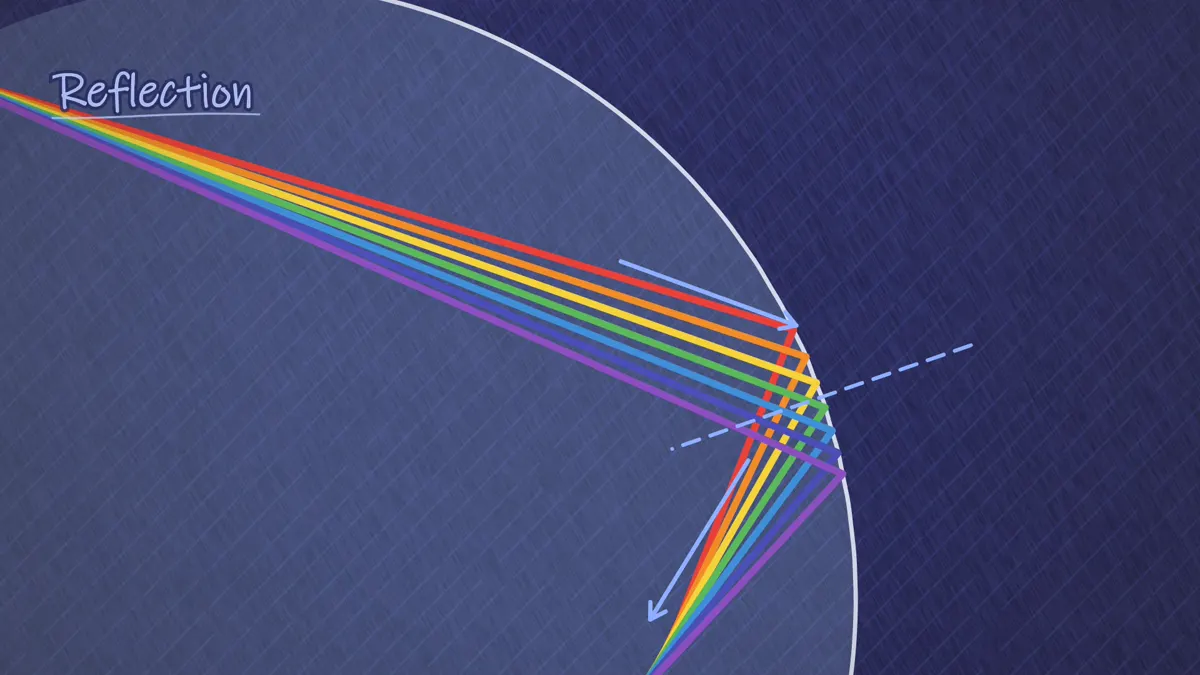
After the bounce, the colors travel back across the drop toward the side where the sunlight came in. When they reach the front surface and leave the water, they bend a second time. That second refraction pushes the colors even further apart.
So every sunbeam that makes a rainbow goes through four events inside one drop.
- Refraction as it enters the drop.
- Dispersion as its colors separate.
- Reflection off the back wall.
- Refraction again as it leaves the drop.
Step 5, the Magic Angle of 42 Degrees
The colored light now comes out of the front of the drop heading back toward the ground. And it doesn’t come out in just any direction.
Light can leave the drop at many angles, but it piles up and shines brightest at one special angle. For red light that angle is about 42 degrees from the line that runs from the Sun, through your head, to the shadow of your head. For violet it is about 40 degrees. The rest of the colors sit in between.
The National Weather Service explains that this angle does not depend on how big the drop is. It depends only on how strongly water bends light. A drizzle droplet and a fat storm drop send their brightest light out at the same angle.
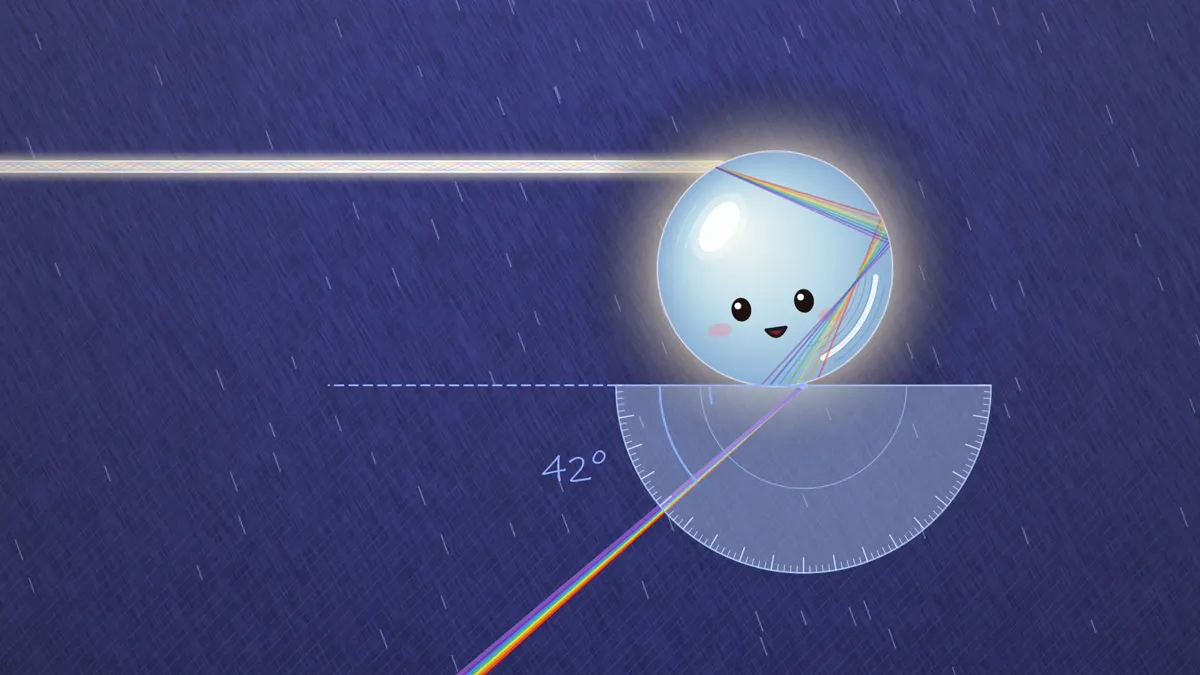
In our video a protractor appears under the drop to measure it. The beam enters straight from the side and the rainbow ray leaves downward at 42 degrees, aimed at the eyes of someone standing on the ground.
| Color | Approximate rainbow angle | Place in the bow |
|---|---|---|
| Red | About 42° | Outer edge |
| Orange and yellow | About 41.5° to 41° | Outer middle |
| Green | About 41° | Middle |
| Blue and indigo | About 40.5° | Inner middle |
| Violet | About 40° | Inner edge |
Only about two degrees separate red from violet. That narrow gap is the whole width of a rainbow. Stretch out your arm and it is roughly the width of your index finger.
Step 6, Each Drop Sends You Only One Color
This is the part most explanations skip, and it surprises almost everyone.
One raindrop sends out all the colors, but each color leaves in a slightly different direction. So only one of those colors can reach your eye from any single drop. The rest fly above or below your head.
Which color you get depends on how high the drop is in the sky. In our video three drops glow one after another, a red one, a green one and a violet one, while a ruler on the side shows their height.
- Higher drops send you their red light. The violet from those drops passes over your head.
- Drops in the middle send you green.
- Lower drops send you violet. Their red light hits the ground in front of you.
That is why red always sits on the outside of the bow and violet on the inside. The rainbow is built from layers of drops, each layer lending you one color.
And because the drops keep falling, the light you see comes from new drops every instant. A drop shines red for you for a split second, drops lower and shines yellow, then green, and then falls out of the bow. The rainbow stays still while the drops that make it are constantly replaced.
Why Are Rainbows Curved?
Now picture every drop in the sky that sits exactly 42 degrees away from the shadow of your head. Where are they?
They form a circle around that shadow point. Every drop on that circle sends you red. Every drop on a slightly smaller circle sends you violet. Put all those circles together and you get a ring of color.
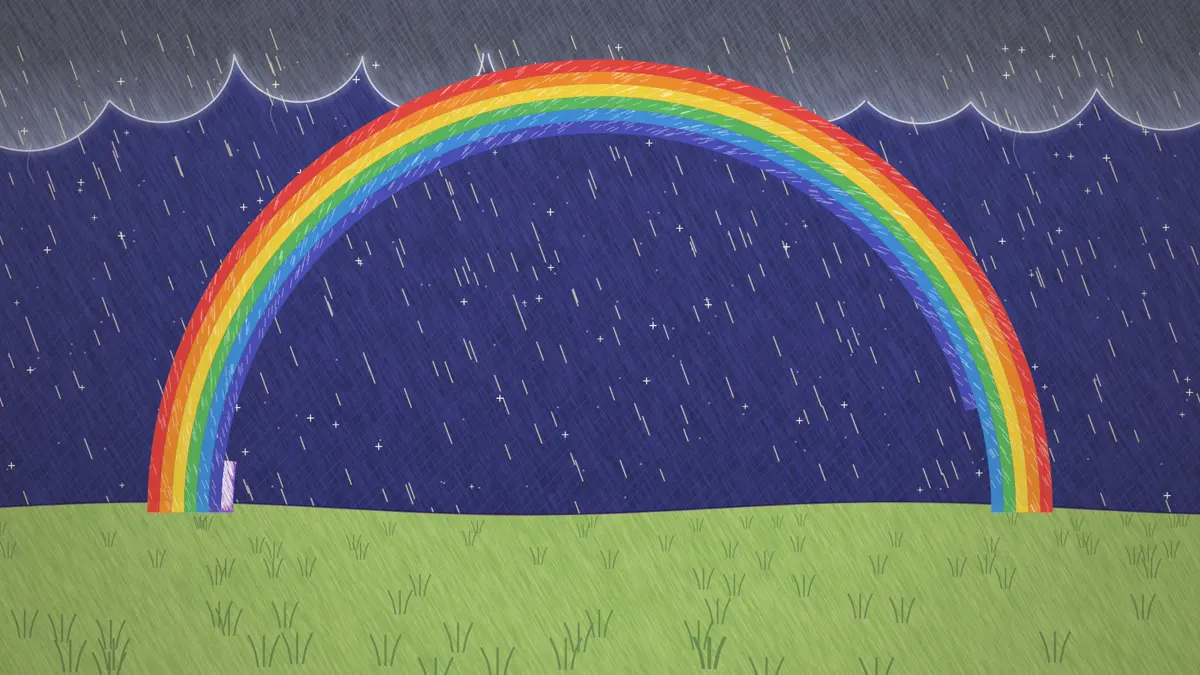
So why do we usually see only half? Because the ground cuts the circle off. The center of the circle is the shadow of your head, which lies below the horizon, so the bottom part of the ring would have to be under your feet.
Pilots and mountain climbers sometimes look down on rain with the Sun behind them. With nothing blocking the view, they can see a complete circular rainbow, often with the shadow of their plane in the middle.
Why you need the Sun low in the sky
The center of the circle always sits exactly opposite the Sun. When the Sun climbs higher, that center sinks lower, and the rainbow sinks with it.
If the Sun is more than 42 degrees above the horizon, the whole bow ends up below the horizon and you can’t see it from the ground. That is why rainbows are most common in the early morning and late afternoon, and rare around noon in summer.
Where to Look for a Rainbow
Now that you know the rules, you can predict a rainbow instead of waiting to be lucky.
- Turn your back to the Sun. The rainbow always appears on the opposite side of the sky.
- Find the shadow of your head. The center of the bow is right there, and the bow itself is about 42 degrees around it.
- Look for rain still falling. A shower moving away from you while the Sun shines from behind is perfect.
- Choose a low Sun. Morning and late afternoon give the tallest arcs.
Rain that falls far away and the cloud it comes from are linked by the same water story. If you want to know how that water got up there in the first place, follow it in our guide to what the water cycle is.
Make your own rainbow
On a sunny day, stand with the Sun behind you and spray a fine mist from a garden hose. Move the spray around until a small bow appears in the droplets.
You can also place a glass of water on a sunny windowsill with a white sheet of paper on the floor. A little band of colors appears on the paper, made by refraction and dispersion through the glass.
Double Rainbows and the Dark Band Between Them
Sometimes a second, fainter rainbow appears outside the first one. This is the secondary rainbow, and it forms when light bounces twice inside each drop instead of once.
Every bounce lets some light escape, so the second bow is always dimmer. It sits at about 51 degrees from the shadow of your head, and the extra reflection flips its colors. In the secondary rainbow, red is on the inside and violet on the outside.
Look closely at the sky between the two bows. It is noticeably darker than the sky inside the main rainbow. This shadowy stripe is called Alexander’s dark band, named after Alexander of Aphrodisias, a Greek thinker who described it about 1,800 years ago.
Why is it darker? The drops in that zone send their light out at angles that miss your eye, either too far inside the first bow or too far outside the second. Meanwhile the area inside the main bow glows brighter, because many drops send weaker, mixed light there.
| Feature | Primary rainbow | Secondary rainbow |
|---|---|---|
| Reflections inside the drop | One | Two |
| Angle from the shadow of your head | About 40° to 42° | About 50° to 53° |
| Color order | Red outside, violet inside | Red inside, violet outside |
| Brightness | Bright | Faint |
Other Rainbows You Might Spot
The same physics creates a whole family of colorful lights in the sky.
- Supernumerary bows. Thin pastel stripes of pink and green just inside the main bow. They appear when drops are small and all about the same size, and they come from light waves overlapping and interfering with each other.
- Moonbows. Rainbows made by moonlight on a bright night with a full Moon. They are so dim that our eyes usually see them as white, although cameras reveal the colors.
- Fogbows. Wide, pale, almost white arcs made by the tiny droplets in fog. The drops are so small that the colors smear together.
- Red rainbows. At sunrise or sunset, sunlight crosses so much air that blue light gets scattered away. Only red and orange are left, so the whole bow glows red.
That last one appears in our video too. A sky full of glowing red drops shows how one color can dominate when it is the only light left to work with.
Why Does Everyone See a Different Rainbow?
Since the rainbow is a circle centered on the shadow of your own head, it moves when you move. Take a step to the left and the whole bow shifts with you.
That means the person next to you is looking at light from a different set of drops. No two people ever see exactly the same rainbow. Even your left eye and your right eye see slightly different ones.
It also explains why nobody has ever reached the end of a rainbow. As you walk toward it, it slides away, always staying at the same angle from your eyes. The legendary pot of gold is perfectly safe.
The Whole Rainbow Process, Step by Step
Let’s put the full journey together, in the same order our animation shows it.
- Sunlight. White light, a mix of all colors, shines from behind you onto falling rain.
- Refraction. The beam slows and bends as it enters a raindrop.
- Dispersion. Each color bends a different amount, so the white light fans out.
- Reflection. The colors bounce off the back of the drop.
- Second refraction. The light bends again as it leaves, spreading the colors further.
- The 42 degree angle. The brightest light leaves at about 42° for red and 40° for violet.
- One color per drop. Higher drops send you red, lower drops send you violet.
- The arc. All the drops at those angles form a circle around the shadow of your head, and the ground hides the bottom half.
Rainbows depend on the size and shape of drops more than people expect. Big drops flatten as they fall, which is why the top of a rainbow is often paler than its sides. Learn more in our guide to what shape a raindrop really is.
Frequently Asked Questions About How a Rainbow Forms
What are the 3 things needed for a rainbow to form?
You need sunlight, water drops in the air and the right position. The Sun must be behind you and low in the sky, and the rain or mist must be in front of you.
What is the order of colors in a rainbow?
From the outside to the inside, the colors are red, orange, yellow, green, blue, indigo and violet. Many people remember them with the name ROY G. BIV. In a secondary rainbow the order is reversed.
Why does a rainbow form at 42 degrees?
Light leaving a raindrop after one reflection is most concentrated at about 42 degrees for red and 40 degrees for violet. This angle comes from how strongly water bends light, and it is the same for small and large drops.
Why are rainbows curved?
All the raindrops that send light to your eye at 42 degrees form a circle around the point directly opposite the Sun. The ground hides the lower part of that circle, so from the ground we usually see an arc.
Can you see a rainbow at noon?
Usually not. If the Sun is higher than 42 degrees above the horizon, the rainbow falls below the horizon. In winter or far from the equator, when the noon Sun stays low, a midday rainbow is possible.
Can you touch a rainbow?
No. A rainbow is not an object in a fixed place. It is light reaching your eyes from many drops at a certain angle, so it moves with you and always stays out of reach.
A Sky Full of Tiny Prisms
Every rainbow is the work of billions of raindrops acting like tiny prisms at the same moment. Refraction bends the sunlight, dispersion splits it, reflection sends it back and the 42 degree angle paints the arc right in front of your eyes.
Next time the Sun comes out during a shower, turn your back to it and look for the shadow of your head. Watch our short video above to see the whole journey of one sunbeam in under a minute, and keep exploring the sky with our guides on clouds, raindrops and storms.