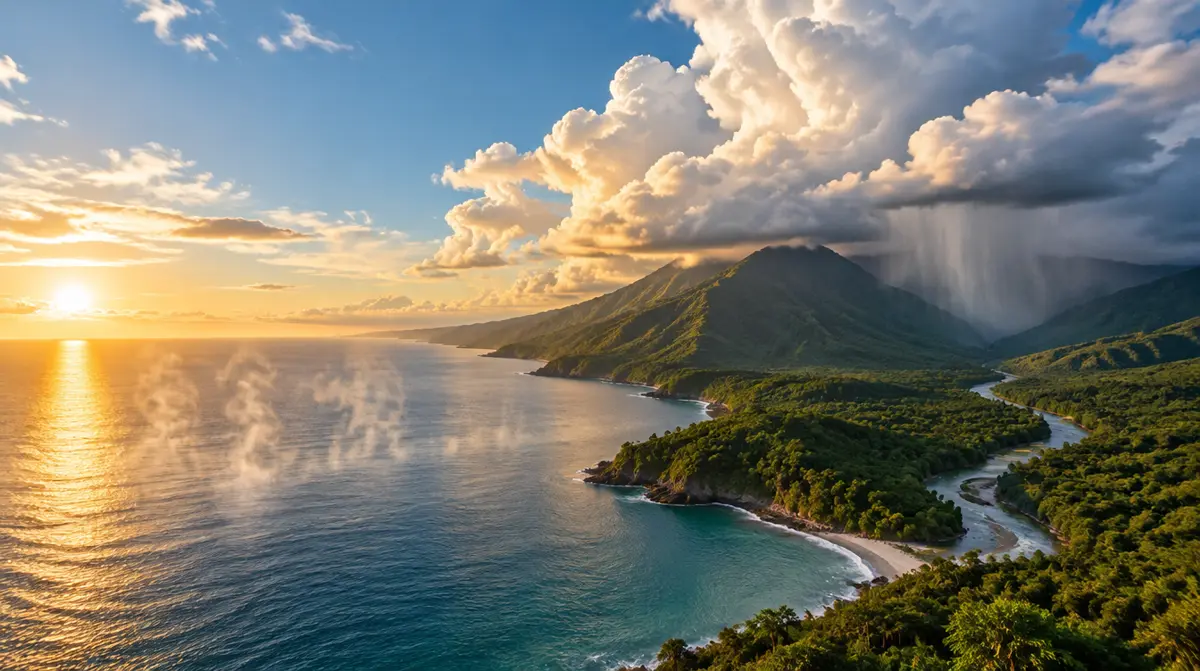
The glass of water on your table is older than the dinosaurs. That same water has been ocean, cloud, snowflake, river and glacier more times than anyone could count.
So what is the water cycle? It is the nonstop movement of water between the oceans, the sky, the land and the ground beneath our feet. Water changes shape along the way, from liquid to gas to ice and back again, but it never really leaves Earth.
In this guide I follow one single raindrop through every stage, the same journey we animated in our short video. By the end you will know exactly what happens in evaporation, condensation, precipitation and collection, and a few stages most explanations skip.
The Water Cycle in One Sentence
The water cycle, also called the hydrologic cycle, is the path water follows as the Sun lifts it into the air and gravity pulls it back down.
Those two forces run the whole system. Sunlight gives water the energy to turn into vapor and rise. Gravity brings it back as rain, sends it downhill in rivers and pushes it deep into the soil.
Does the cycle start somewhere? Not really. It is a loop with no first step and no last step. Scientists usually begin the story in the ocean only because that is where most of the water is.
And the total amount barely changes. Earth has roughly the same water today that it had millions of years ago. What changes is where that water sits and in what form.
Where Earth’s Water Is Stored
Before following our raindrop, it helps to know the places water waits between trips. Scientists call them pools or reservoirs.
According to NOAA, about 97% of all water on Earth is salty ocean water. Only around 2.5% is fresh water, and most of that is locked away.
| Water reservoir | Share |
|---|---|
| Oceans (salt water) | About 97% of all water |
| Glaciers, ice sheets and permanent snow | About 68% of fresh water |
| Groundwater | About 30% of fresh water |
| Lakes, rivers and wetlands | About 0.25% of fresh water |
Look at that last row. The rivers and lakes we drink from hold a tiny fraction of the planet’s water. That is why the water cycle matters so much. It keeps refilling that small supply again and again.
Step 1 of the Water Cycle: Evaporation
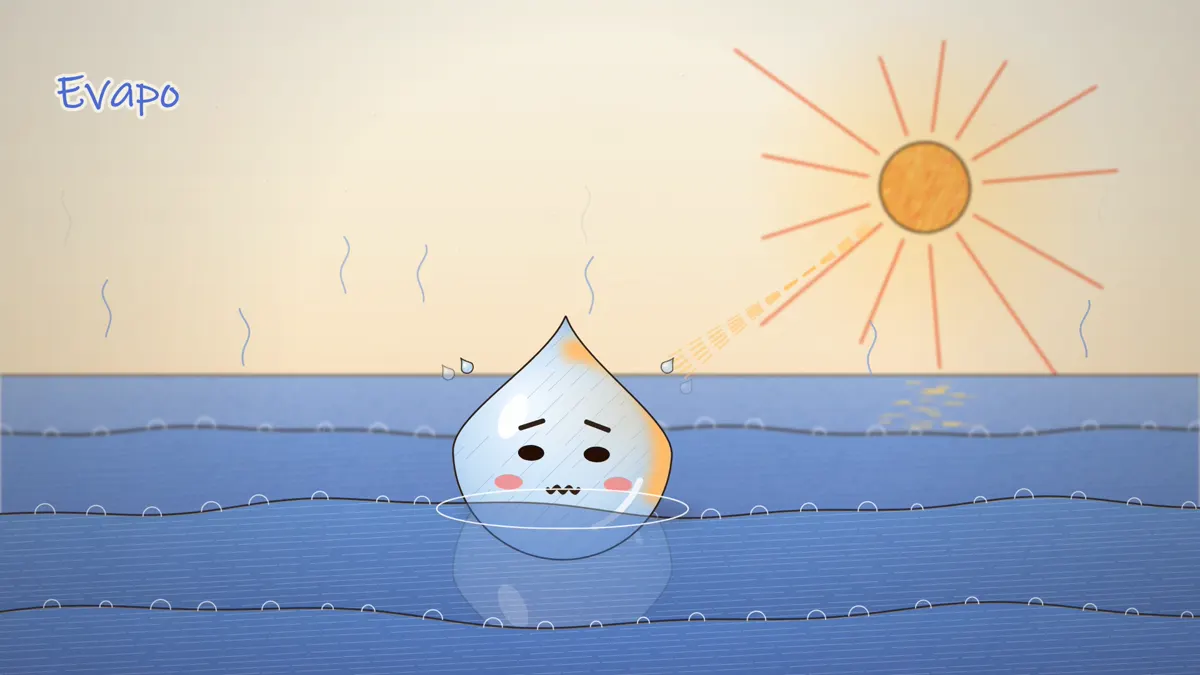
Our raindrop starts its life as part of a warm, calm sea. The Sun shines on the surface and the water molecules at the top start moving faster and faster.
When a molecule gains enough energy, it breaks free from its neighbors and floats up as an invisible gas called water vapor. That escape is evaporation.
Why doesn’t the salt go with it? Because salt can’t turn into vapor at ocean temperatures. Only the water leaves, so evaporation works like a giant natural purifier. Salty sea water rises as fresh water.
The oceans supply most of the vapor in the air. Researchers estimate they provide around 86% of all global evaporation, which makes sense when you remember how much of the planet they cover.
What speeds up evaporation?
- Heat gives molecules more energy to escape.
- Wind carries away the moist air right above the surface, making room for more vapor.
- Dry air can accept more water than air that is already humid.
- A large surface exposes more molecules to the Sun.
You see this every day. A puddle vanishes faster on a hot, windy afternoon than on a cool, still night.
Transpiration and Sublimation, the Hidden Ways Water Rises
The ocean is not the only place water climbs into the sky. Plants and ice do it too, quietly.
Transpiration happens when plants pull water up from their roots and release vapor through tiny pores in their leaves. A big tree can release hundreds of liters on a hot summer day. Scientists often combine this with evaporation from soil and call it evapotranspiration.
Sublimation is even stranger. On cold, sunny, windy mountain tops, snow and ice can turn straight into vapor without ever melting. The water skips the liquid stage completely.
The reverse also exists. When vapor turns directly into ice crystals, it is called deposition, and it is how frost grows on a cold window.
Step 2 of the Water Cycle: Condensation and Cloud Formation
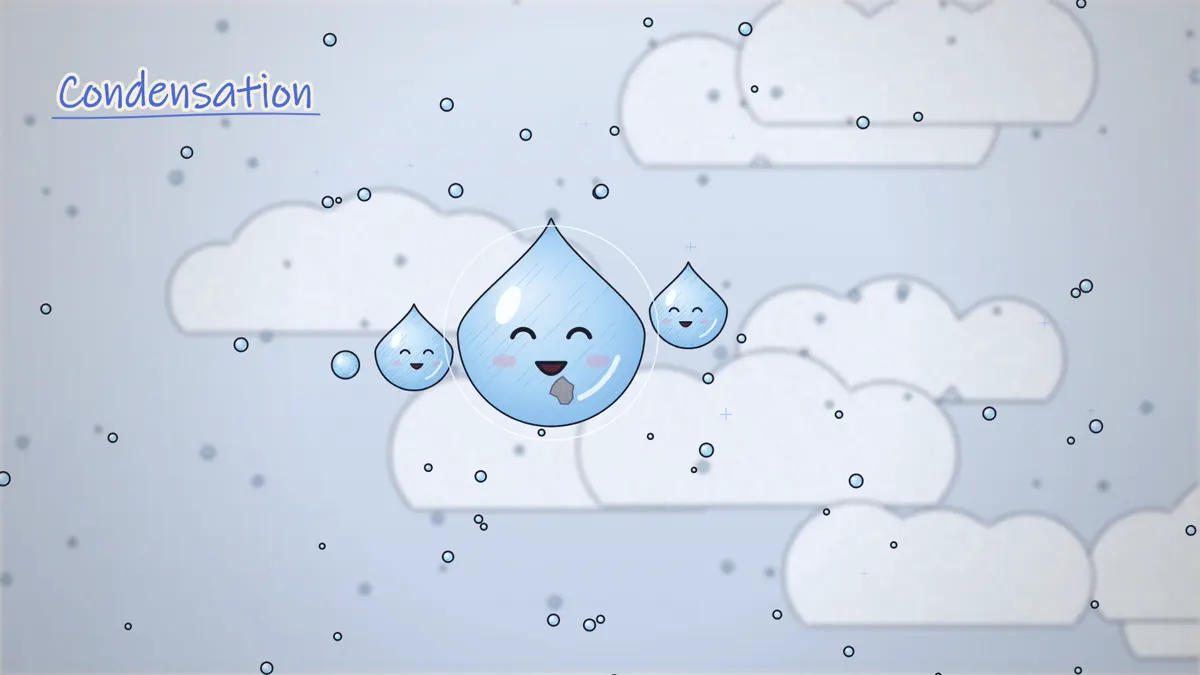
Now our raindrop is a tiny bit of vapor rising with warm air. The higher it goes, the lower the air pressure, and the air expands and cools down.
Cold air can’t hold as much vapor as warm air. At a certain point, called the dew point, the vapor starts turning back into liquid water. That change is condensation.
But vapor needs something to hold on to. It wraps around microscopic specks floating in the air, like dust, sea salt, pollen or smoke. These specks are called condensation nuclei, and without them clouds would barely form.
Billions of these droplets together make a cloud. Each one is so small and light that rising air keeps it floating. If you want the full story of why something made of water can hang in the sky, read our guide on why clouds float.
Condensation you can see at home
Pour an ice-cold drink and wait a minute. Drops appear on the outside of the glass.
That water didn’t leak through. It came from the air around the glass, which cooled down on contact and released its vapor as liquid. It is the same process that builds a cloud, only on a much smaller scale.
Fog, dew on morning grass and a steamy bathroom mirror all work the same way.
Step 3 of the Water Cycle: Precipitation
A cloud droplet is far too small to fall as rain. It would need about a million droplets joined together to make one ordinary raindrop.
So how does our raindrop grow? Inside the cloud, droplets crash into each other and merge, a process called coalescence. In colder clouds, ice crystals grow by stealing vapor from nearby droplets, then melt on their way down.
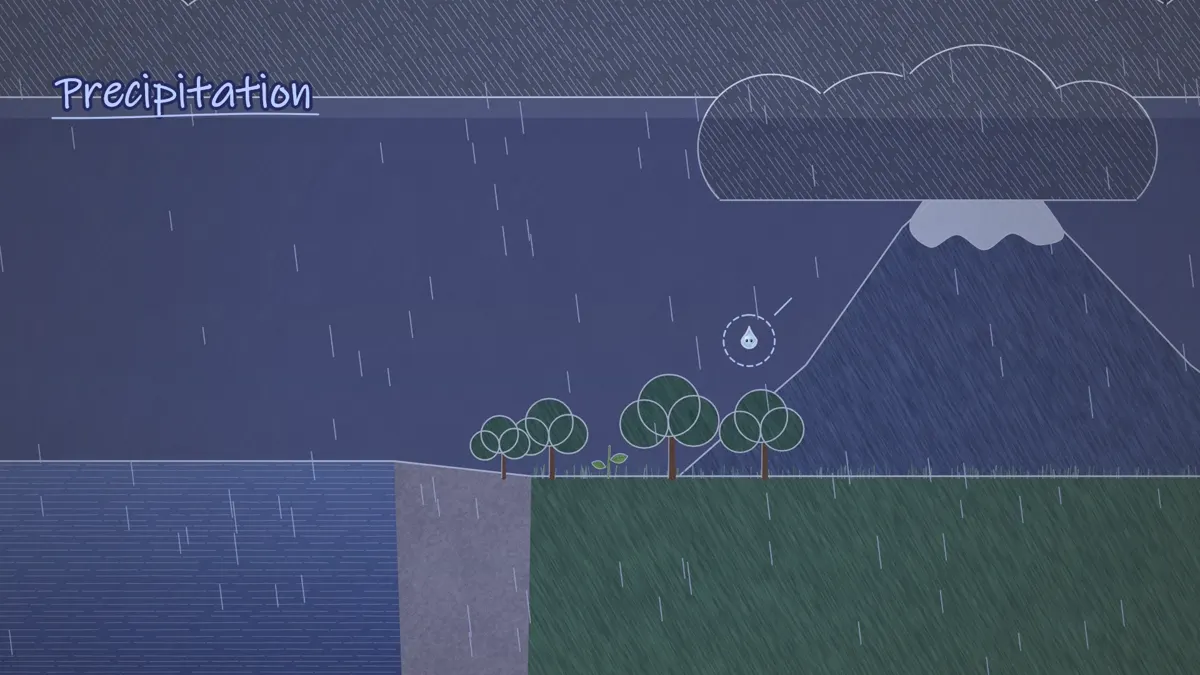
When the drop becomes too heavy for the rising air to support, gravity wins. Water falls back to Earth as precipitation.
And here’s a surprise. A falling raindrop isn’t shaped like a tear. Air pushes against its bottom and flattens it into something closer to a little bun. We explain it in detail in what shape a raindrop really is.
Types of precipitation
| Type | How it forms |
|---|---|
| Rain | Liquid drops that stay above freezing all the way down |
| Snow | Ice crystals that never melt because the air stays cold |
| Sleet | Rain that refreezes into ice pellets in a cold layer near the ground |
| Freezing rain | Liquid drops that freeze the moment they touch a cold surface |
| Hail | Ice balls tossed up and down inside storm clouds, growing layer by layer |
The temperature of the air between the cloud and the ground decides which one you get. The same cloud can drop rain on a valley and snow on the mountain next to it.
Step 4 of the Water Cycle: Collection, Runoff and Infiltration
Our raindrop hits the ground. What happens next depends on where it lands, and this is the part of the journey most simple explanations rush through.
Runoff, the fast road back to the sea
If the drop lands on a slope, on rock or on pavement, it can’t sink in. It slides downhill and joins other drops in tiny streams. This is surface runoff.
Streams join creeks, creeks join rivers, and rivers carry the water back to the ocean. Along the way, runoff carves valleys and moves soil, which is why the water cycle also shapes the landscape.
Infiltration and groundwater, the slow road
If the drop lands on soft soil or a forest floor, it soaks in. That is infiltration.
Some of the water stays near the surface as soil moisture, where roots drink it. Some keeps moving down through cracks and sand, a step called percolation, until it reaches a layer of rock or sediment already full of water. That underground store is called an aquifer, and the water in it is groundwater.
Groundwater moves very slowly. It can stay underground for years or even thousands of years before it comes back up in a spring, feeds a river or gets pumped from a well.
Snowmelt and ice
If our drop fell as snow on a mountain, it may wait until spring. Then the snow melts and feeds rivers just when farms and towns need water most. If it landed on a glacier, it could stay frozen for centuries.
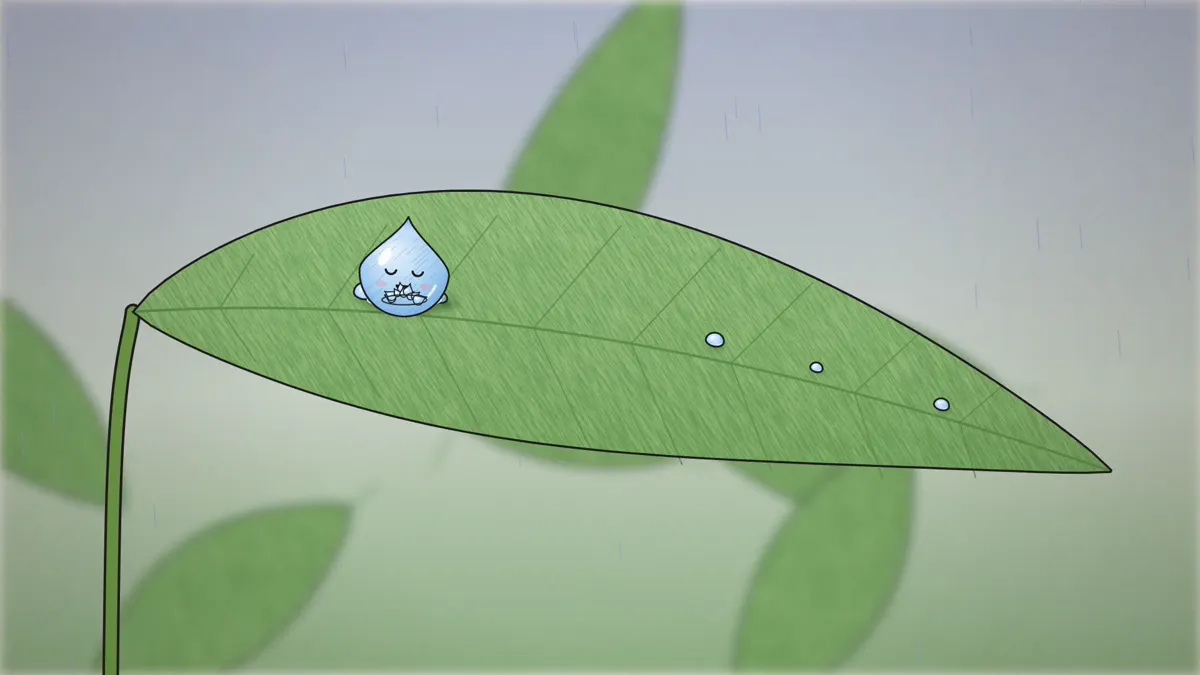
How Long Does a Water Molecule Stay in Each Place?
Every stop on the journey has its own pace. Scientists call this the residence time, and the differences are huge.
| Place | Typical time |
|---|---|
| Atmosphere | About 9 days |
| Rivers | 2 to 6 months |
| Soil moisture | 1 to 2 months |
| Lakes | 50 to 100 years |
| Deep groundwater | Up to 10,000 years |
| Oceans | About 3,200 years |
| Antarctic ice | Up to 20,000 years or more |
So the vapor in today’s sky will probably fall as rain within about a week and a half. The water in the Antarctic ice, on the other hand, fell as snow before the first cities were built.
How the Water Cycle Works as One Connected System
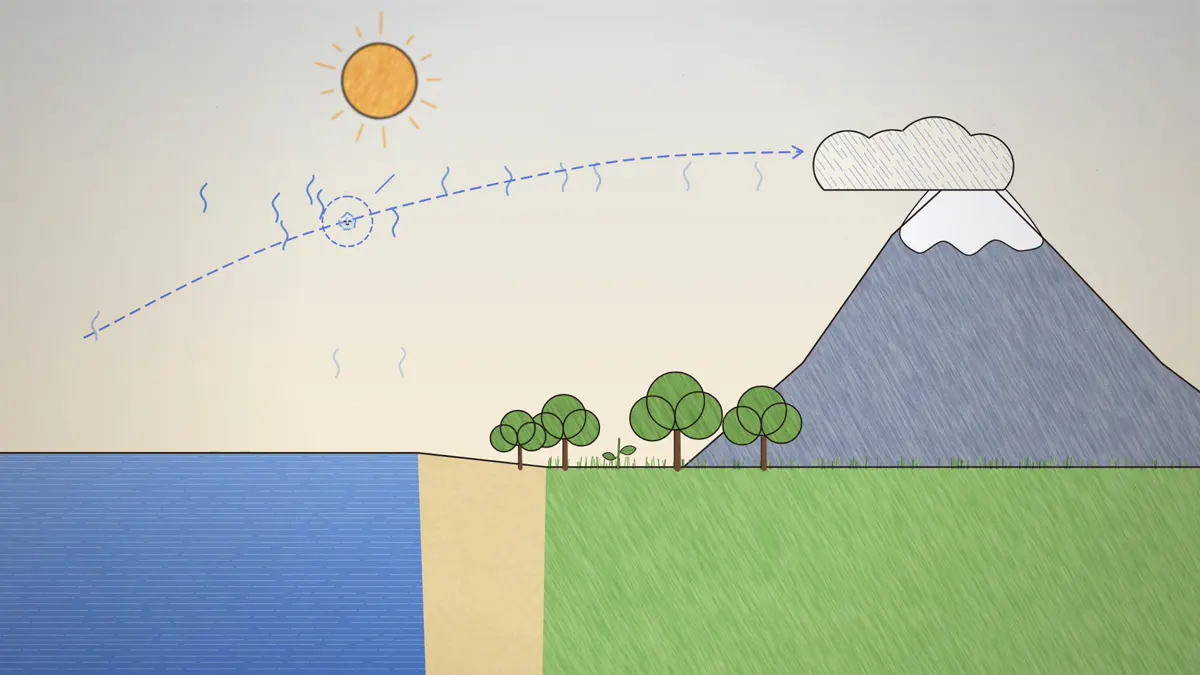
Let’s put our raindrop’s whole trip together.
- Evaporation. The Sun warms the ocean and water rises as vapor, leaving the salt behind.
- Transportation. Wind carries that moist air across oceans and continents, sometimes thousands of kilometers.
- Condensation. The air rises and cools, and vapor forms droplets around tiny particles, building clouds.
- Precipitation. Droplets merge until they are heavy enough to fall as rain, snow, sleet or hail.
- Collection. Water runs off into rivers, soaks into groundwater, waits as snow and ice, or is drunk by plants that release it again through transpiration.
- Return. Rivers and groundwater flow back to the sea, and the journey begins once more.
Notice that the stages overlap. While one drop evaporates from a lake, another is falling as snow and another is moving through an aquifer. Everything happens at the same time, all over the planet.
Weather is simply the water cycle we can feel. A storm, a dry spell or a foggy morning is one piece of this system showing itself in your neighborhood.
Why Is the Water Cycle Important?
Without the water cycle, every lake would eventually dry up and all the fresh water on land would drain into the salty sea. Life on land as we know it couldn’t exist.
- It delivers fresh water. Evaporation cleans salt from sea water and rain carries it inland to forests, farms and cities.
- It moves heat. Evaporation absorbs heat at the surface and condensation releases it high in the sky, spreading warmth around the globe and fueling storms.
- It shapes the land. Rivers and glaciers carve canyons, build deltas and carry nutrients to the sea.
- It supports every ecosystem. Wetlands, rainforests and coral reefs all depend on water arriving at the right time and in the right amount.
Humans depend on it in a direct way too. The tap in your kitchen, the crops in the market and the electricity from a hydroelectric dam are all fed by water that fell from the sky.
How Humans and Climate Change Affect the Water Cycle
The USGS points out that people now change the water cycle as much as nature does in many places.
Dams and reservoirs store river water and change where and when it flows. Pumping groundwater faster than rain refills it can empty aquifers that took thousands of years to fill. Concrete and asphalt stop infiltration, so more rain turns into fast runoff and city floods.
Climate is changing the cycle as well. Warmer air holds more water vapor, about 7% more for every degree Celsius. That extra moisture means heavier downpours when it rains, and longer, drier gaps between rains in some regions.
Can we help? Yes. Protecting wetlands and forests, letting rain soak into gardens instead of drains, and using water carefully all keep the cycle healthier.
Easy Ways to See the Water Cycle at Home
The best way to understand the water cycle is to watch it happen. These three tiny experiments take a few minutes.
- Water cycle in a bag. Put a little water with a drop of blue food coloring in a sealed plastic bag and tape it to a sunny window. In a few hours you will see vapor condense at the top and “rain” run down the sides.
- Cloud in a jar. Pour some hot water in a jar, cover it with a plate of ice cubes and add a puff of air from a blown-out match. A small cloud forms inside, proving that cooling vapor needs particles to condense on.
- Plant transpiration. Tie a clear bag around a leafy branch on a sunny day. By afternoon, drops of water collect inside, all released by the leaves.
Frequently Asked Questions About the Water Cycle
What are the 4 main stages of the water cycle?
The four main stages are evaporation, condensation, precipitation and collection. Many scientists add transpiration, sublimation, infiltration and runoff to describe the cycle in more detail.
What drives the water cycle?
Energy from the Sun drives evaporation and lifts water into the atmosphere. Gravity pulls it back down as precipitation and moves it downhill through rivers and into the ground.
Is the water we drink today the same water dinosaurs drank?
Yes, mostly. Earth keeps reusing the same water, so the molecules in your glass have very likely been part of oceans, clouds and glaciers for millions of years, including the age of the dinosaurs.
Does the water cycle ever stop?
No. As long as the Sun shines and gravity pulls, water keeps moving. The speed changes with seasons and climate, but the cycle has no beginning and no end.
Why is the water cycle also called the hydrologic cycle?
“Hydro” comes from the Greek word for water. Hydrology is the science that studies water, so the hydrologic cycle simply means the cycle of water.
How long does one full trip through the water cycle take?
It can take a few days or many thousands of years. A drop that evaporates and rains again quickly may finish a loop in about nine days, while a drop trapped in deep groundwater or Antarctic ice may wait over ten thousand years.
The Endless Journey of a Single Raindrop
The water cycle is the reason a drop that left the ocean last week can fall on your window today. Evaporation lifts it, condensation gathers it, precipitation brings it down and collection sends it home, and then it all starts again.
Next time it rains, remember that each drop is a traveler that has been around the planet countless times. Watch our short video above to see the whole journey in under a minute, and keep exploring the sky with our guides on clouds and raindrops.