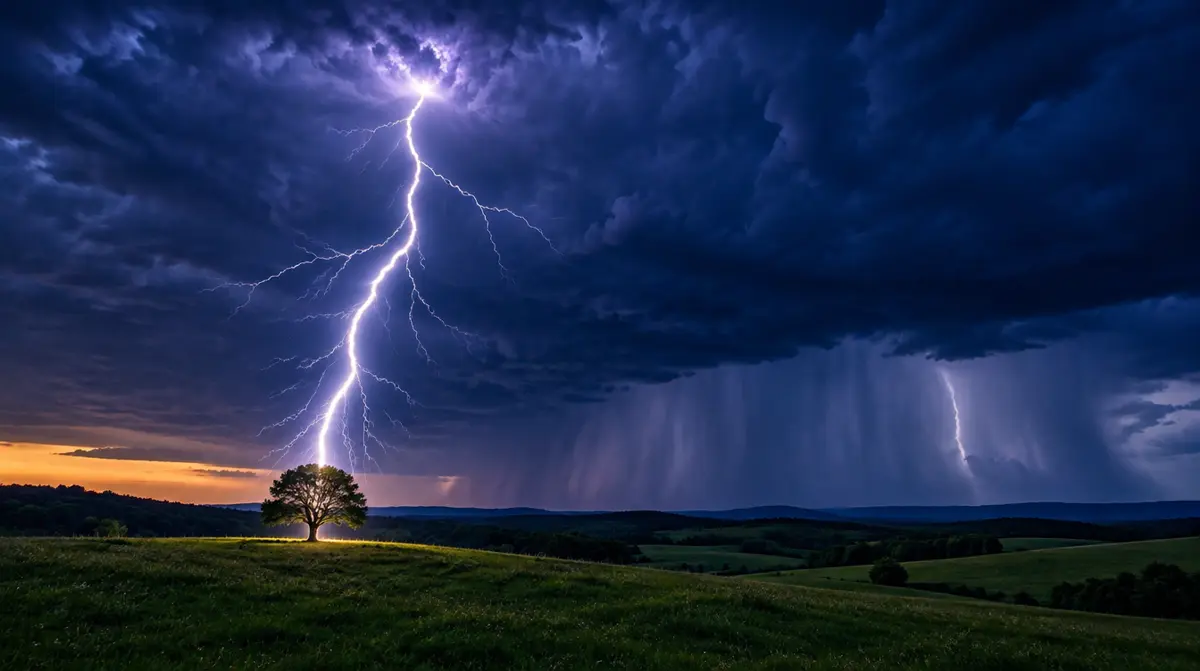
A flash lights up the sky. You hold your breath, and a few seconds later the whole house seems to shake.
So what causes thunder? Lightning heats a thin tube of air to about 30,000 °C in a few millionths of a second. That air has no time to move politely out of the way. It explodes outward as a shock wave, and the shock wave reaches our ears as a crack, a boom or a long rumble.
In this guide we follow the same storm we animated in our short video, step by step. We start with a tiny drop of water rising inside a cloud and end with the boom that makes a rabbit jump. Along the way you will learn how to tell how far away a storm is and how to stay safe while it passes.
What Causes Thunder in One Sentence
Thunder is the sound of air being heated so fast by lightning that it bursts outward, then rushes back in.
That is the whole secret. There is no thunder without lightning, and there is no lightning that stays silent. Every single bolt makes thunder, even when it is too far away for us to hear it.
Why do we see the flash first? Because light is almost unbelievably fast and sound is slow. The flash reaches us practically at once, while the sound walks through the air at roughly 343 meters per second. That gap is the reason the rabbit in our video has time to start its stopwatch.
To understand the boom, though, we have to go back to the beginning. Thunder is the last link in a chain that starts with water and ice inside a storm cloud.
Step 1. Water Climbs Into a Thunderstorm Cloud
Every thunderstorm starts with the water cycle. Warm, moist air rises, cools and condenses into droplets, just as we described in what is the water cycle.
In an ordinary cloud the air rises gently. In a thunderstorm cloud, called a cumulonimbus, the rising air becomes a powerful elevator called an updraft. It can carry droplets many kilometers up, far above the height where water freezes.
That is the moment our little drop in the video starts to change. As it climbs past the freezing line, it turns into ice. Some drops become tiny ice crystals, and others grow into soft, heavier pellets of rimed ice called graupel, a bit like small snowballs.
Why does freezing matter? Because without ice, there is almost no lightning. A cloud full of only liquid water rarely builds up enough electricity to make a bolt. The ice is what turns a rain cloud into a thunderstorm.
Step 2. Collisions Separate the Charges
Inside the cloud, the updraft pushes small ice crystals upward while heavier graupel falls or hangs lower. They pass each other millions of times, and every time they touch they bump and rub.
Each collision moves a little electric charge from one particle to the other. In the main part of a storm, the light ice crystals usually end up positive and the heavier graupel usually ends up negative. Scientists call this charge separation.
Then the updraft finishes the sorting. It carries the light positive crystals to the top of the cloud, often into the flat anvil. The heavy negative graupel stays in the middle and lower part.
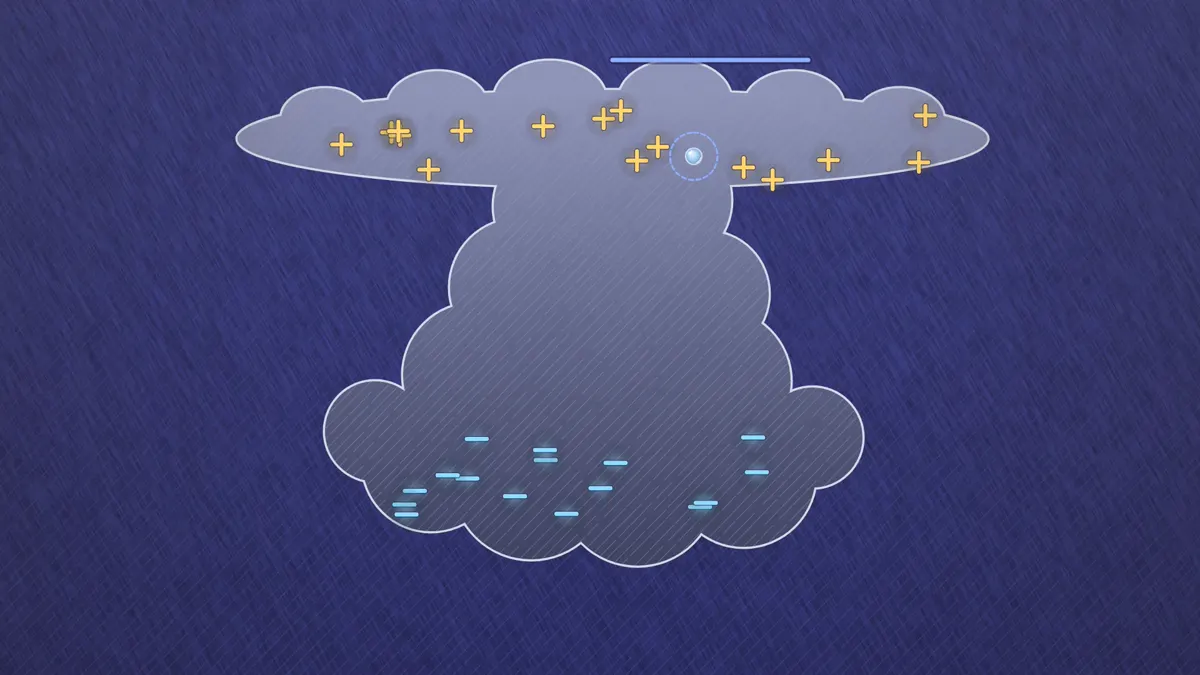
The cloud has become a giant natural battery. One end is positive, the other is negative, and the difference keeps growing as long as the updraft keeps working.
The ground answers the cloud
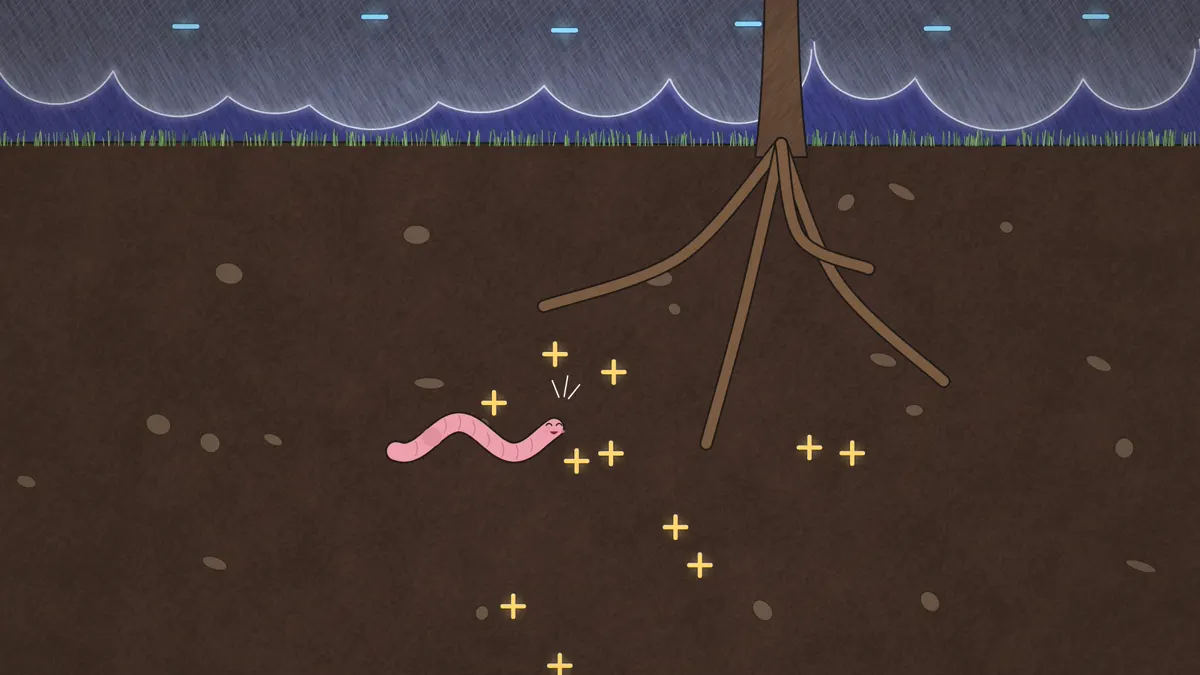
Now look down. Opposite charges attract, so the big pool of negative charge in the bottom of the cloud pulls positive charge in the ground toward the surface.
This is the part we love showing in the video. The positive charges travel up through the soil, past a surprised worm, and along tree roots, then gather on tall, pointy things like trees, poles, rooftops and even the tip of a leaf. Our drop feels it too and its little hairs stand on end.
That tingle is real. People caught near a strong storm sometimes feel their hair rise. It is a warning sign that the air around them is charged and a strike could be close.
Step 3. The Stepped Leader Reaches Down
Air is a very good insulator. It normally refuses to carry electricity, which is why the charges can pile up for so long.
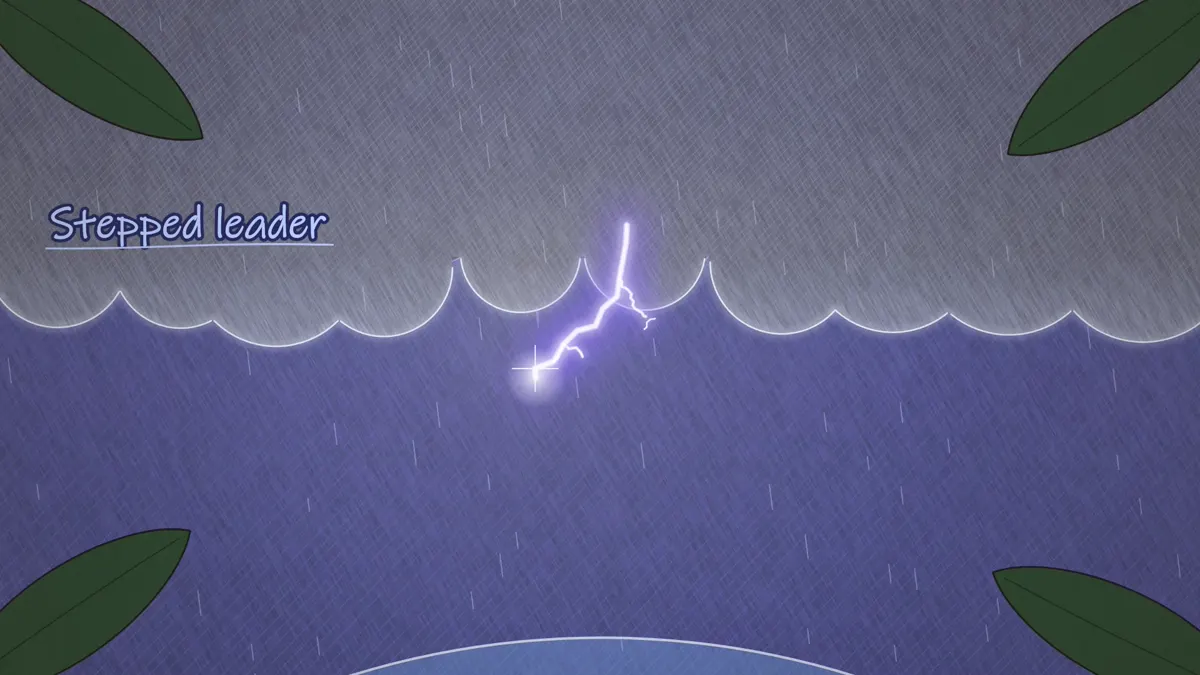
But every insulator has a limit. When the charge difference becomes huge, the air near the bottom of the cloud breaks down and a faint, branching channel of charged air starts to crawl downward. This is the stepped leader.
It does not fall in one smooth line. It moves in short jumps of tens of meters, pausing, branching and trying new paths, which is why lightning ends up looking zigzag. It is also very hard to see, much dimmer than the bright flash that comes next.
Streamers rise to meet it
As the leader gets close to the ground, the positive charges waiting on trees and leaves can’t hold back anymore. They send up thin sparks of their own called streamers.
In our video a streamer rises from the drop sitting on the leaf. In nature, many streamers often reach up at once from different objects. Only one wins. The first streamer to touch the leader decides where the lightning strikes.
Step 4. The Return Stroke, the Flash We See
The moment leader and streamer connect, a complete path opens between the cloud and the ground. A massive current races up that path from the ground to the cloud. This is the return stroke, and it is the blinding flash our eyes catch.
Surprised that it travels upward? Most people are. The leader comes down, but the brightest part of the bolt actually runs from the ground back up into the cloud, so fast that our eyes can’t tell the direction.
Often the same channel flashes again a few times in less than a second. That is why some lightning bolts seem to flicker. Each new stroke heats the air again and adds to the thunder.
Step 5. The Air Gets Hotter Than the Sun’s Surface
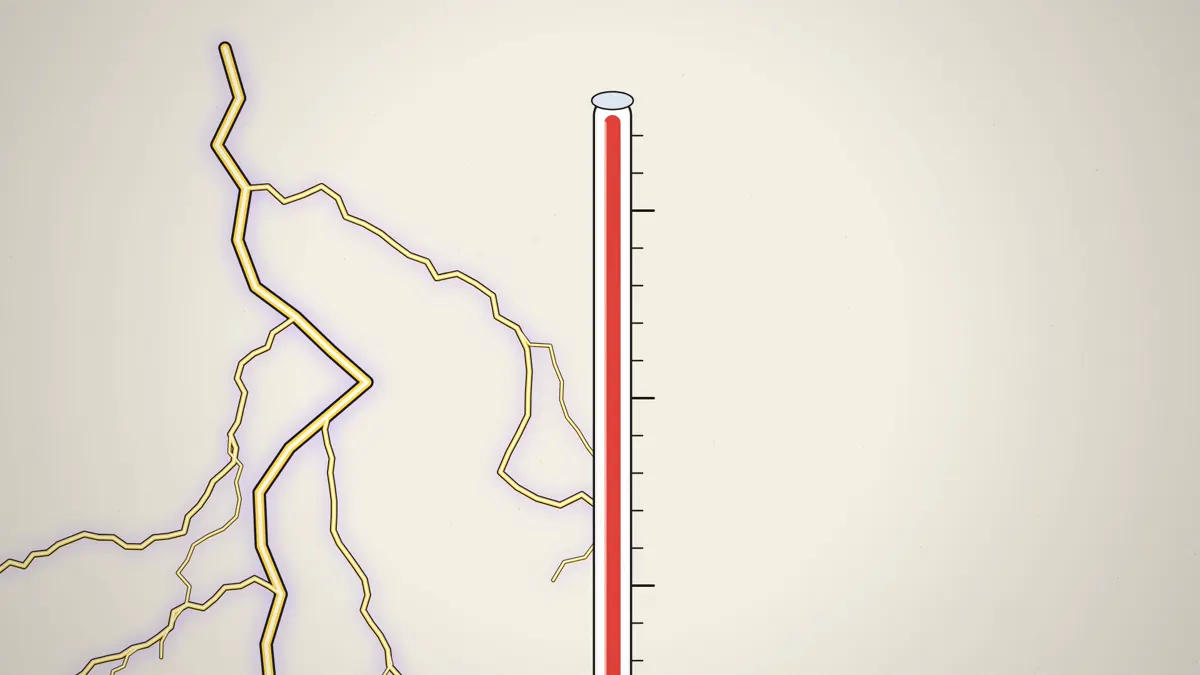
Here is where the thunder is born. The current in the return stroke squeezes through a channel only about as wide as a thumb, a few centimeters across.
All that energy turns into heat in a tiny space. According to the National Weather Service, the air in the channel can reach about 50,000 °F, roughly 30,000 °C. That is around five times hotter than the surface of the Sun.
| Something hot | Approximate temperature |
|---|---|
| Boiling water | 100 °C |
| Kitchen oven at full heat | About 250 °C |
| Molten lava | About 700 to 1,200 °C |
| Surface of the Sun | About 5,500 °C |
| Air inside a lightning channel | About 30,000 °C |
The most important detail isn’t just how hot it gets. It is how fast. The heating happens in a few millionths of a second, far faster than the air can spread out.
Step 6. The Shock Wave, the Real Answer to What Causes Thunder
When you heat air, it wants to expand. Usually it does this slowly, like warm air drifting up from a radiator.
Lightning gives the air no time. The pressure inside the channel suddenly jumps to many times normal air pressure. The heated air slams outward and shoves the cooler air around it, packing the molecules together into a thin, dense layer. That layer of squeezed air racing away from the bolt is a shock wave.
In our video we put a magnifying glass on it. You can see the air particles crowded together in a tight band at the edge of the wave, with calmer, evenly spaced air ahead of it.
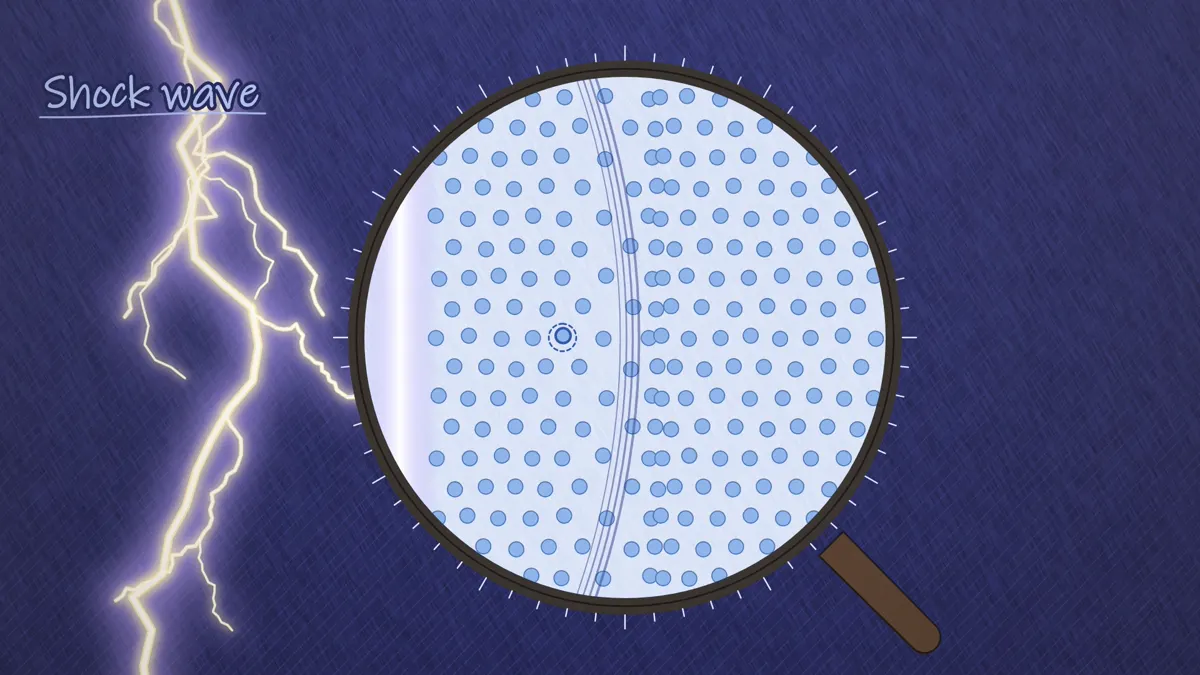
Close to the bolt, within a few meters, this shock wave moves faster than sound and can split tree bark or shatter glass. As it spreads it quickly loses energy and slows down to the normal speed of sound. From then on it travels as an ordinary sound wave, and that sound wave is what we call thunder.
Right after the flash, the channel cools and the air rushes back in. That fast expansion and collapse is what gives thunder its punch, a bit like a giant clap of two invisible hands.
Why lightning and thunder are really one event
Lightning is the electricity. Thunder is what that electricity does to the air. They happen at the same instant and in the same place, and only the difference in speed between light and sound pulls them apart for us.
Why Does Thunder Rumble Instead of Just Booming?
If the shock wave starts in one instant, why do we sometimes hear a growl that lasts ten or twenty seconds?
The answer is the shape of the bolt. A lightning channel can be several kilometers long, and every part of it makes sound at the same moment. The part closest to you arrives first, while the sound from the far end of the channel or from a branch high in the cloud arrives seconds later. Your ears hear all those arrivals one after another, stretched into a long roll.
| What you hear | What it usually means |
|---|---|
| Sharp crack or snap | The strike was very close, within a few hundred meters |
| Loud single boom | A nearby bolt, with most of its channel at a similar distance from you |
| Long rolling rumble | A distant or long, branching bolt, plus echoes from hills and buildings |
| Flash with no sound | Lightning too far away for its thunder to reach you, often called heat lightning |
Hills, buildings and layers of warm and cool air add their own echoes. The air also soaks up high pitches faster than low ones, so far away thunder sounds deeper and softer, while close thunder sounds sharp and bright.
How far can thunder travel? The National Weather Service says it is usually heard up to about 10 miles, around 16 kilometers, from the strike. Wind, terrain and traffic noise can shorten that distance a lot.
How Far Away Is the Storm? The Flash to Bang Count
Remember the rabbit with the stopwatch at the start of our video? It is doing the most useful thunder trick there is.
Sound in air travels about 1 kilometer every 3 seconds, or 1 mile every 5 seconds. Light arrives almost instantly. So the number of seconds between the flash and the bang tells you the distance.
- When you see the flash, start counting seconds. “One thousand one, one thousand two” works if you don’t have a watch.
- Stop when you hear the thunder.
- Divide by 3 for kilometers, or by 5 for miles.
| Seconds from flash to thunder | Distance to the lightning |
|---|---|
| 3 seconds | About 1 km (0.6 miles) |
| 5 seconds | About 1.7 km (1 mile) |
| 15 seconds | About 5 km (3 miles) |
| 30 seconds | About 10 km (6 miles) |
Count a few flashes in a row. If the number of seconds keeps shrinking, the storm is coming toward you. If it keeps growing, the storm is moving away.
The speed of sound changes a little with temperature. It is faster in warm air and slower in cold air, but the simple 3 second or 5 second rule is close enough for everyday use.
Lightning Safety, When Thunder Roars Go Indoors
Counting is a fun experiment, but it is not a safety plan. Lightning can strike 10 miles or more from the rain, sometimes out of what looks like a clear patch of sky. If you can hear thunder at all, you are close enough to be struck.
For years people used the 30-30 rule. Go inside if the flash to bang count is 30 seconds or less, and wait 30 minutes after the last thunder before going out. Today the National Weather Service keeps the second half and drops the first. Its message is simpler and safer.
- When thunder roars, go indoors. Don’t wait to count. The first thunder you hear is your signal.
- Wait 30 minutes after the last thunder before going back outside. Many strikes happen as a storm arrives or leaves.
- Safe places are buildings with plumbing and wiring, or a car or truck with a hard metal roof and the windows closed.
- Not safe are open fields, beaches, tents, picnic shelters, sheds, and spots under a lone tree.
- Get out of the water. Pools, lakes and the sea are dangerous during a storm.
- Indoors, stay away from corded phones, plumbing and windows, and avoid baths and showers until the storm passes.
Our video ends with a lone tree being struck for a reason. Tall, isolated objects send up the strongest streamers, so the tree that looks like shelter is often the most likely target. If you ever feel your hair stand up outdoors, move to a safe place right away.
Thunder Myths and Surprising Facts
Long before anyone knew about shock waves, people blamed thunder on clouds crashing together or gods throwing hammers. Some myths still hang around today.
- Myth, clouds bumping together make thunder. Clouds are soft collections of droplets and can’t bang. The sound only comes from lightning heating the air.
- Myth, heat lightning is a special silent lightning. It is ordinary lightning too far away for its thunder to reach you.
- Myth, lightning never strikes the same place twice. Tall towers and mountain peaks are hit many times every year.
- Fact, thunder can happen in a snowstorm. It is called thundersnow, and falling snow muffles the sound so much that it is heard only close by.
- Fact, volcanic eruptions can make lightning and thunder. Ash particles colliding in the plume separate charges in a similar way.
Thunderstorms also give us gentler sights. When the storm moves on and the Sun breaks through behind you, look for the colors on the falling rain, explained in how a rainbow forms.
Frequently Asked Questions About Thunder
What causes thunder in simple words?
Lightning heats the air around it to about 30,000 °C in a split second. The air expands so fast that it pushes the surrounding air into a shock wave, which becomes the loud sound we hear as thunder.
Can there be thunder without lightning?
No. Every thunder comes from a lightning bolt. Sometimes the lightning is hidden inside a cloud or behind hills, so we hear thunder without seeing a flash.
Why do we see lightning before we hear thunder?
Light travels almost a million times faster than sound. The flash reaches us almost instantly, while thunder travels at roughly 343 meters per second, about one kilometer every three seconds.
How hot is lightning?
The air in a lightning channel can reach about 50,000 °F, roughly 30,000 °C, which is around five times hotter than the surface of the Sun.
How far away can you hear thunder?
Thunder is usually heard up to about 10 miles, around 16 kilometers, from the lightning strike. Wind, hills and background noise can make that distance shorter.
Is the 30-30 rule still used for lightning safety?
Only the second part. The National Weather Service now advises going indoors as soon as you hear any thunder, and waiting 30 minutes after the last thunder before going back outside.
From a Frozen Drop to a Rolling Boom
Thunder is the final echo of a long chain. Ice collides and separates charges, the stepped leader reaches down, a streamer reaches up, the return stroke heats the air and the shock wave carries the boom to our ears.
Next time a storm rolls in, count the seconds from the safety of your home and picture that thumb-wide tube of air bursting outward. Watch our short video above to see the whole journey in under a minute, then keep exploring the sky with our guide on why clouds float.